
Shower Tips & Lifestyle
Shower Water Pressure in Singapore: Why Stronger Isn’t Always Better
Mar
Quick answer: Shower water pressure in Singapore is rarely the thing that needs fixing, and a stronger stream does not rinse you any cleaner. What people usually want is better spray coverage and a warmer, fuller feel, which is a design problem rather than a plumbing one. Water temperature and shower length affect skin far more than force does.
Shower pressure is an unglamorous thing to spend an evening reading about. It also happens to be the single most common complaint in HDB and older condo bathrooms, and the advice available is mostly guesswork dressed up as engineering. Worth setting out what is actually known, and what is being sold to you.
What shower water pressure actually is
Two separate things get bundled under the word pressure. The first is the static pressure in your pipes, set by your building’s supply and largely outside your control as a resident. The second is flow rate, meaning how much water passes through the head each minute, and how that water is shaped as it leaves.
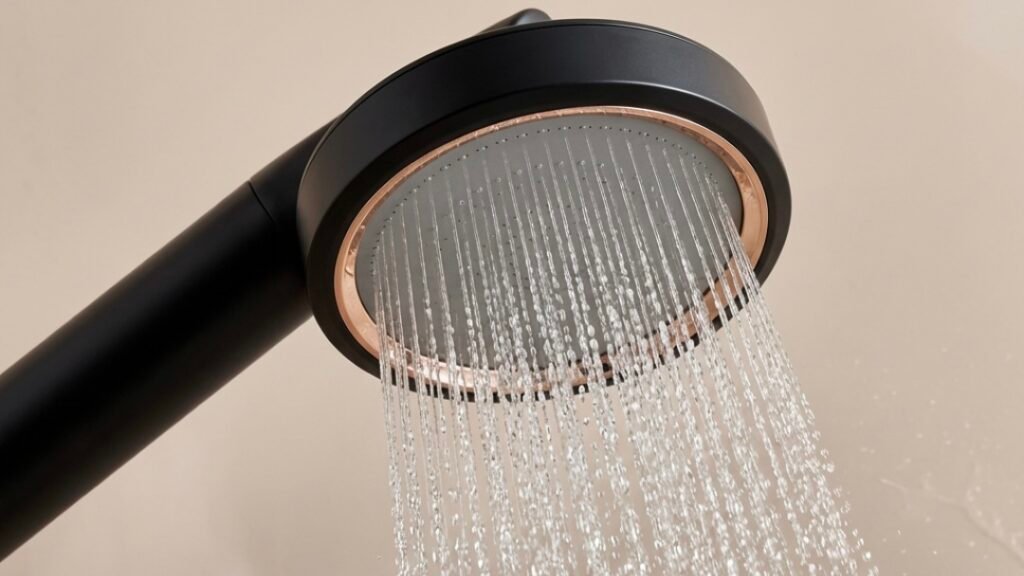
Almost every complaint about a weak shower is really about the second one. The supply is fine. The head is scattering the water into a wide, soft spread that loses its punch before it reaches you. Narrow the openings and angle them, and the same volume of water arrives feeling considerably stronger. Nothing about the plumbing changed.
That distinction matters because it decides what you should buy. If you have already worked through the usual checks for improving shower pressure at home and nothing helped, the head is where to look next.
Why stronger does not mean cleaner
A hard stream feels efficient. It rinses shampoo faster, it drums on your shoulders, and it creates a strong impression of a deeper clean. The impression is doing most of the work here.
Rinsing is a matter of contact between water and skin, not of impact. Once soap is off, more force adds nothing except water down the drain. This is why a well-designed head at moderate flow can leave you feeling better rinsed than a blunt high-flow one: coverage beats force, every time.
There is a claim circulating that high pressure damages the skin barrier. Being straight about it, the evidence for that specific mechanism is thin, and you should be sceptical of anyone selling you a shower head on the strength of it. What dermatology does consistently point to is heat and duration. Long hot showers strip skin lipids. A shorter, cooler shower will do more for tight skin than any change in pressure.
The part that often gets blamed on shower water pressure
When someone tells us the shower feels harsh, pressure is the word they reach for, but the complaint underneath is usually about how their skin feels afterwards. That is worth separating out, because it has a different cause and a different fix.
Singapore’s water carries a disinfectant residual all the way to the tap. PUB puts it plainly: “Ammonia is added to the treated water to form chloramines, a more stable chlorine residual.” For January to December 2025, PUB reported average chlorine of 2.27 mg/L and average monochloramine of 2.10 mg/L. The water is safe. PUB conducts over 500,000 tests a year and meets WHO guidelines, and nothing here should be read as an argument against drinking from the tap.
Safe to drink is a different question from optimal for ten minutes of daily skin contact. In this climate most of us shower twice a day, so contact time adds up in a way it does not in cooler countries. The narrower evidence base is worth stating honestly: a 2003 study in the Journal of Dermatology found chlorine at 1.0 to 2.0 mg/L reduced stratum corneum hydration in patients with atopic dermatitis, and that finding has not been shown to extend to everyone else.
If any of that sounds like your situation, the water quality question is covered in more depth in the piece on whether Singapore’s water is hard or soft, which also explains why a softener is the wrong purchase here.
Who should chase more pressure, and who should not
Worth pursuing if your rinse genuinely takes longer than it used to, if you live on a high floor of an older block, if you have long or thick hair that is hard to rinse through, or if the head is more than a few years old and has never been descaled.
Leave it alone if your shower is fine and you are only asking because an advertisement suggested it should be stronger. Leave it alone too if what you actually want is relief from tight skin, since more force will not deliver that and may make a long hot shower feel more tempting rather than less.
Your options
1. Descale what you already own
The cheapest fix, and often the only one needed. Mineral and soap residue narrows spray holes unevenly over the years, which is why an old head feels both weak and badly aimed.
Best for: any head older than two or three years that has never been cleaned properly.
Skip if: the head is new, or you have already descaled it this year with no improvement.
2. Check the hose and the tap before buying anything
A kinked or over-long hose costs you flow, and a partly closed isolation valve behind the tap is a surprisingly common culprit after renovation work.
Best for: anyone whose pressure dropped suddenly rather than gradually.
Skip if: the shower has always been weak since you moved in.
3. A shower head designed around spray geometry
Where the water is shaped rather than merely released, perceived pressure rises without drawing more from the supply. Aera Flow uses triangular micro-jet spray holes designed to increase perceived pressure by up to 50% while cutting water use by 30 to 50%. Priced at S$99, the Nourish handshower is the entry point into that spray design, and the wider vitamin C shower head range covers the same geometry with filtration built in.
Best for: older flats where the supply is adequate but the shower feels flat.
Skip if: your building has a genuine supply problem, which a new head cannot solve.
4. Filtration alongside the spray design
Suitable for households where skin comfort is the real complaint and pressure is the symptom being described, the Radiance handshower at S$149 combines the same spray geometry with Vitae Infusion, carrying 25,000 mg of vitamin C with glycerin, milk extract and aloe vera to help neutralise chlorine. One refill is included, and refills last 2 to 3 months at S$29.90 each or three for S$74.90.
Best for: daily showering on chlorine-sensitive skin.
Skip if: your only goal is more force, in which case the filtration is spend you do not need.
A common worry at this point is whether adding filtration costs you flow. It is a fair question and covered separately in the piece on filters and water pressure.
What to expect after changing the head
Week 1 to 2. The difference in coverage registers immediately, and it is usually larger than people expect. Give yourself a fortnight before judging, because the first few showers feel unfamiliar rather than better.
Month 1 to 2. Shower length often drops without anyone deciding to shorten it, simply because rinsing finishes sooner. If your water bill is metered per household, this is roughly when it shows.
Month 3 to 6. Descale on a schedule from here, whatever you bought. Spray holes clog gradually and the decline is slow enough that you stop noticing it until the shower feels weak again.
Frequently asked questions
Is shower water pressure in Singapore generally poor?
Supply is generally reliable. Most complaints trace back to the shower head, the hose, a partly closed valve, or years of accumulated residue rather than to the building’s water supply.
Does a higher flow rate clean better?
No. Once soap and shampoo have been rinsed away, extra volume adds nothing. Spray coverage across your body matters considerably more than the force of any single jet.
Can high pressure damage your skin?
The evidence for pressure specifically is weak, and we would rather say so than sell you something on it. Water temperature and shower duration are the factors with real support behind them.
Will a new shower head fit my HDB bathroom?
Standard threading is used across HDB and condo bathrooms in Singapore, so a handshower swap is usually a two-minute job with no plumber and no tools beyond your hands.
Do water-saving heads feel weaker?
Not necessarily, and often the reverse. Narrowing and angling the openings raises the perceived strength of the spray while lowering the volume that passes through it.
Does the SUHAE filter reduce the pressure?
The filtration sits inside a head built around Aera Flow spray geometry, so the design accounts for it rather than bolting a restriction onto an existing head. Replacing a spent refill on schedule matters here, since a clogged cartridge is what actually costs you flow.
References
- PUB, Singapore Drinking Water Quality, January to December 2025. https://www.pub.gov.sg/-/media/PUB/PDF/SG-Drinking-Water-Quality.pdf
- PUB, Water Treatment. https://www.pub.gov.sg/Public/WaterLoop/Water-Treatment
- Seki T, et al. Effects of chlorine on the skin barrier. J Dermatol, 2003. PMID 12692355. https://pubmed.ncbi.nlm.nih.gov/12692355/
If your shower feels weak, start with the free fixes: descale the head, straighten the hose, check the valve. If it still disappoints after that, the fault is in how the water is being shaped, and that is worth solving properly. The vitamin C shower head range is where to start.
