
Water Quality & Chlorine
Is Singapore Water Hard or Soft? What PUB’s Numbers Show
Jul
Quick answer: Is Singapore water hard or soft? It is soft. PUB’s own drinking water quality report puts average total hardness at 42.7 mg/L, which sits well inside the band normally classified as soft. So if your skin feels tight after a shower here, hardness is unlikely to be the reason. Chlorine contact time is the more useful thing to look at.
Most people land here after buying a clarifying shampoo, switching moisturiser twice, and still stepping out of the shower with skin that feels tight. Hard water is the usual suspect, largely because most of the advice online was written for the United States or the United Kingdom, where it often is. Singapore is a different case, and the numbers are public.
What water hardness actually measures
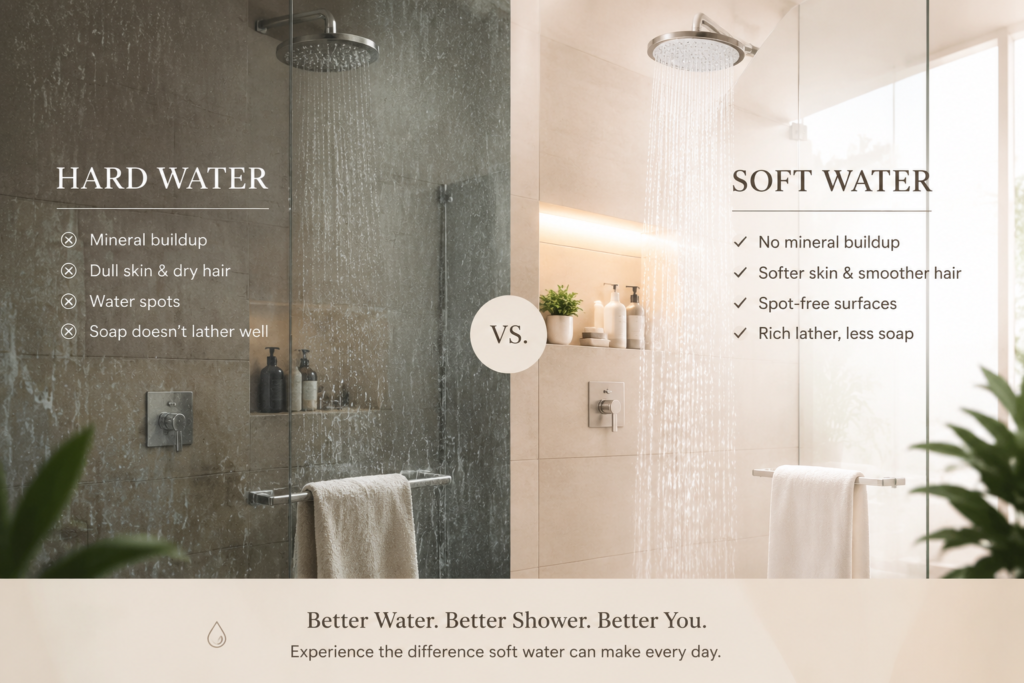
Hardness is a measure of dissolved calcium and magnesium, picked up as water moves through limestone, chalk and other mineral-bearing rock. It gets reported in milligrams per litre of calcium carbonate equivalent. Below roughly 60 mg/L water is classified as soft. From 60 to 120 mg/L it is moderately hard, and past 180 mg/L it is very hard.
Those dissolved minerals produce the symptoms people recognise. Soap that will not lather properly. White scale creeping across the glass and the tapware. Two water quality engineers have written a readable account of why hardness varies so widely between regions, worth reading if you have moved here from somewhere the water behaved differently.
Is Singapore water hard or soft? What PUB’s numbers say
PUB publishes a full drinking water quality report every year. For January to December 2025, the figures that bear on this question are these:
- Total hardness: average 42.7 mg/L, range 7.24 to 191 mg/L
- Chlorine: average 2.27 mg/L, range 1.43 to 2.87 mg/L
- Monochloramine: average 2.10 mg/L, range 1.29 to 2.70 mg/L
- pH: average 8.0, range 7.5 to 8.9
42.7 mg/L falls in the soft band. The top of the reported range does reach into moderately hard territory, so a handful of readings across the island will run higher than the average, but the typical HDB or condo tap is delivering soft water. For most households that one number settles the question.
It also means a domestic water softener is solving a problem Singapore does not really have. If you have been weighing that purchase, the comparison between a softener and a shower filter in local conditions covers the cost and plumbing side in more detail.
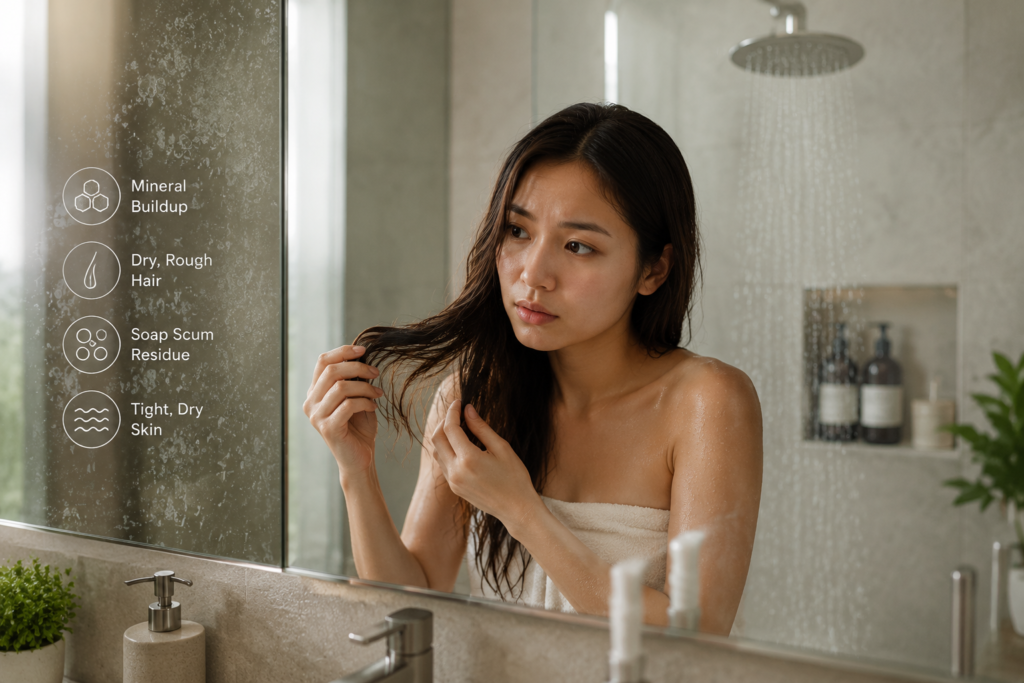
So if the water is soft, why does my skin still feel tight?
Here is where the hard water framing sends people down the wrong path. Singapore does not disinfect with free chlorine alone. PUB describes the step in its own words: “Ammonia is added to the treated water to form chloramines, a more stable chlorine residual.” Stability is exactly the point. A chloramine residual holds all the way through the distribution network to your tap, which is what keeps the water safe over the distance it has to travel.
None of that is a safety argument. PUB water meets WHO guidelines, over 500,000 tests are conducted annually, and the lab holds SAC-SINGLAS ISO/IEC 17025 accreditation. Safe to drink is simply a different question from optimal for ten minutes of daily skin contact, and it is the second question a shower filter is aimed at.
The evidence on skin is narrower than most marketing suggests, so it is worth stating precisely. In a 2003 study in the Journal of Dermatology, Seki and colleagues found that chlorine at 1.0 to 2.0 mg/L reduced stratum corneum hydration in patients with atopic dermatitis. That finding belongs to that group and has not been shown to extend to the general population. What is defensible is the chemistry: ascorbic acid reacts with chlorine and chloramine in water, which is the mechanism behind vitamin C shower filtration.
The climate does the rest of the work. Warm and humid most of the year, most of us shower twice a day. Daily exposure is what turns a small effect into something you might actually notice, and it is also why treated water still carries a chlorine residual by the time it reaches you.
Who this matters for, and who can skip it
Worth a look if you shower twice daily, have atopic or reactive skin, keep colour-treated hair, or can smell chlorine in the bathroom when the hot water runs. Also worth a look if you have recently moved into an older block and noticed a change you cannot pin down.
Probably skip it if your skin is comfortable as things stand. Skip it too if the thing bothering you is scale on the shower screen, because at 42.7 mg/L that residue is far more likely to be soap scum than mineral deposit, and no filter will touch it.
Your options, honestly compared
1. Do nothing: the baseline worth naming
Best for: anyone without a complaint. Singapore water is safe and soft, and there is no health reason to filter it.
Skip if: you have a persistent skin or hair issue you have already tried to solve through products.
2. A whole-home water softener: built for a different problem
Best for: homes in genuinely hard water regions, where scale damages appliances.
Skip if: you are in Singapore. Softeners exchange calcium and magnesium for sodium, and at 42.7 mg/L there is very little to exchange. The plumbing work and running cost buy you almost nothing here.
3. A universal shower filter: the retrofit route
Fitted between the hose and the existing head, an inline filter leaves your current hardware alone. The universal retrofit filter range starts at S$49.90 and fits standard HDB and condo threading without a plumber.
Best for: renters, recent renovations, and anyone unwilling to replace a shower head they already like.
Skip if: your existing head has weak flow, since a filter will not improve it.
4. A filtering shower head: one piece of hardware
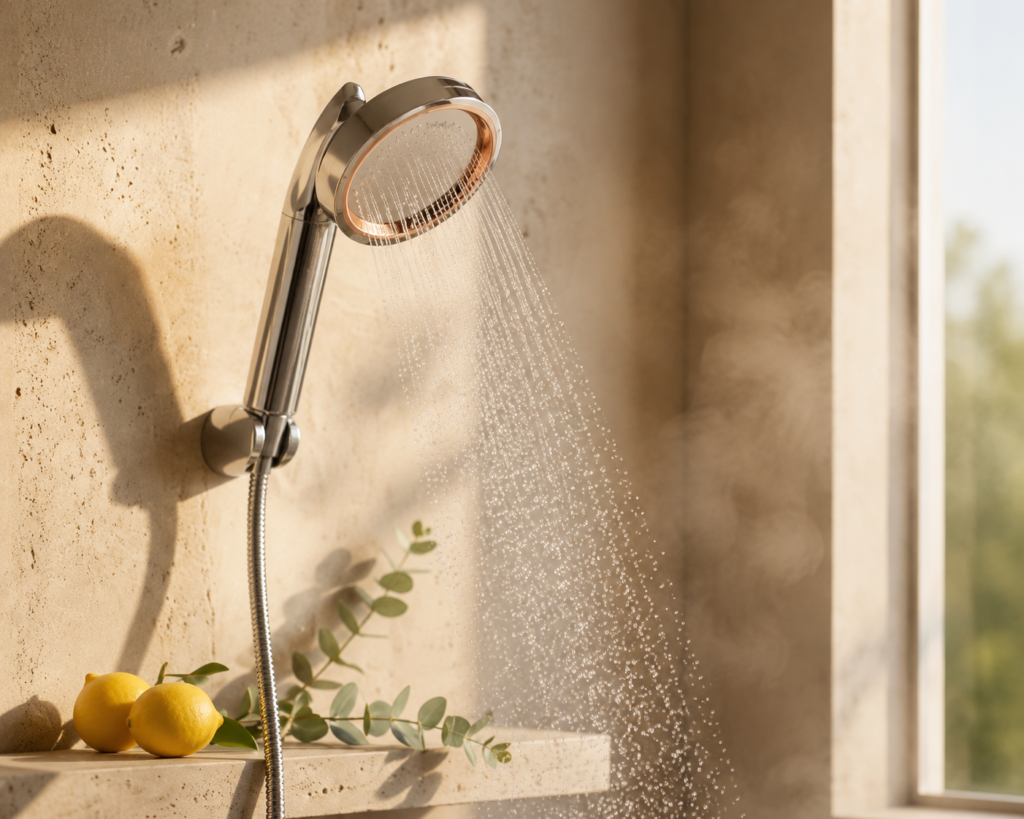
Suitable for daily use where both flow and filtration matter, the Radiance handshower runs at S$149 and includes one Vitae refill. It pairs Vitae Infusion, which carries 25,000 mg of vitamin C with glycerin, milk extract and aloe vera, with Purea Core three-step filtration on SGS-tested materials showing no detectable cadmium, lead, mercury or hexavalent chromium. Refills run 2 to 3 months at S$29.90, or three for S$74.90.
Best for: households replacing a tired shower head anyway, or anyone in an older flat where perceived pressure is also a complaint. Aera Flow micro-jet spray holes are designed to raise perceived pressure by up to 50% while cutting water use.
Skip if: your shower head is new and you would rather not replace it.
What to expect if you do fit a filter
Week 1 to 2. The change most people report first is the smell. Chlorine odour in the cubicle drops off once the water is treated at the point of use. Skin feel is harder to judge this early, because you are paying attention to it for the first time in years.
Month 1 to 2. Long enough for a fair read. If tightness after showering was going to ease, this is roughly when you would know. Colour-treated hair is often where people notice it soonest.
Month 3 to 6. By now the answer is either that it helped or it did not, and either outcome is useful. Keep replacing the refill on schedule, because a spent cartridge is the same as no filter at all.
Frequently asked questions
Is Singapore tap water hard?
No. PUB reports average total hardness of 42.7 mg/L for 2025, which classifies as soft. Some individual readings across the network run higher, but the average is not close to the hard threshold.
Is Singapore tap water safe to drink?
Yes. PUB states that its water meets WHO drinking water guidelines, and the utility has been a WHO Collaborating Centre since 2012. Nothing on this page should be read as a reason to stop drinking from the tap.
Then why is there still chlorine in my shower water?
A disinfectant residual has to survive the whole journey through the distribution network. PUB adds ammonia to form chloramine specifically because it is more stable than free chlorine, so it is still present when the water reaches your bathroom.
Will a shower filter stop limescale on my shower screen?
Unlikely, and this is the most common mismatch of expectations. At Singapore hardness levels most of that residue is soap scum and product build-up rather than mineral scale, so a filter is the wrong tool for it.
Does boiling water get rid of chlorine?
Partly, and not in a way that helps with showering. There is a fuller answer on boiling and chlorine in Singapore homes, but it does nothing for the water leaving your shower head.
How often does a SUHAE Vitae refill need changing?
Typically every 2 to 3 months, depending on how many people use the shower and how long each session runs. Refills are S$29.90 each, or three for S$74.90.
References
- PUB, Singapore Drinking Water Quality, January to December 2025. https://www.pub.gov.sg/-/media/PUB/PDF/SG-Drinking-Water-Quality.pdf
- PUB, Water Treatment. https://www.pub.gov.sg/Public/WaterLoop/Water-Treatment
- PUB, Water Quality. https://www.pub.gov.sg/Public/WaterLoop/Water-Quality
- Seki T, et al. Effects of chlorine on the skin barrier. J Dermatol, 2003. PMID 12692355. https://pubmed.ncbi.nlm.nih.gov/12692355/
If you came here to find out whether the water is hard, the answer is no, and you can stop worrying about that particular variable. If the tight-skin problem is still unsolved, the thing worth changing is what the water carries rather than what it is missing. Start with the universal shower filter range, which retrofits to the hardware you already own.
