
Water Quality & Chlorine
Why Vitamin C Shower Filters Are Becoming Popular in Singapore

Jun
Quick answer: The vitamin C shower filter Singapore households keep buying has caught on for one reason that holds up: it targets the thing PUB’s own testing confirms is at the tap, a chloramine residual averaging 2.10 mg/L. Ascorbic acid reacts with that residual on contact, which is why the format works at shower temperature and shower speed where slower media struggle. Popularity is not evidence, so the rest of this covers what the chemistry supports and what it does not.
These started appearing in local bathroom renovation threads and skincare groups a few years ago and have not gone away. Some of that is genuine word of mouth. Some of it is a vitamin on a label doing marketing work it has not earned. Separating the two is the useful exercise.
What is actually in the water
Start with published numbers rather than atmosphere. PUB’s Singapore Drinking Water Quality report for January to December 2025 gives free chlorine an average of 2.27 mg/L across a range of 1.43 to 2.87, monochloramine an average of 2.10 mg/L, and pH an average of 8.0. Total hardness averages 42.7 mg/L, which classifies as soft, so mineral content is not the issue anyone here is solving.
The residual is deliberate, and PUB says so in plain language: “Ammonia is added to the treated water to form chloramines, a more stable chlorine residual.” Stability is the design goal. It has to survive the journey through the distribution network and still be doing its job in the riser of a twenty-storey block. That is exactly why it is still present when the water reaches your shower.
None of that makes the water a problem to drink. It does mean that in a climate where most people shower once or twice a day, the cumulative contact between skin and a disinfectant residual is not trivial, and the reason chlorine is still in treated tap water at all is worth understanding before deciding whether to do anything about it.
Why ascorbic acid rather than carbon
The interesting constraint in any shower filter is time. Water spends a fraction of a second inside the housing at typical flow rates. That single fact rules out a lot of otherwise good filtration.
Activated carbon works by adsorption, holding contaminants on a large internal surface area. It works well under a kitchen sink, where contact time is generous. At shower flow it has far less opportunity to work, and chloramine is more stubborn for carbon than free chlorine is.
Ascorbic acid takes a different route. It reacts chemically with the residual rather than trapping it, and the reaction is fast enough to complete in the time available. Heat helps rather than hinders, which matters when most people shower warm. There is a trade-off attached: reactive media are consumed as they work, so a cartridge has a defined life measured in a couple of months, not years. That is the price of the speed. The wider comparison of what different filter media are made of and how each behaves sets out where each one earns its place.
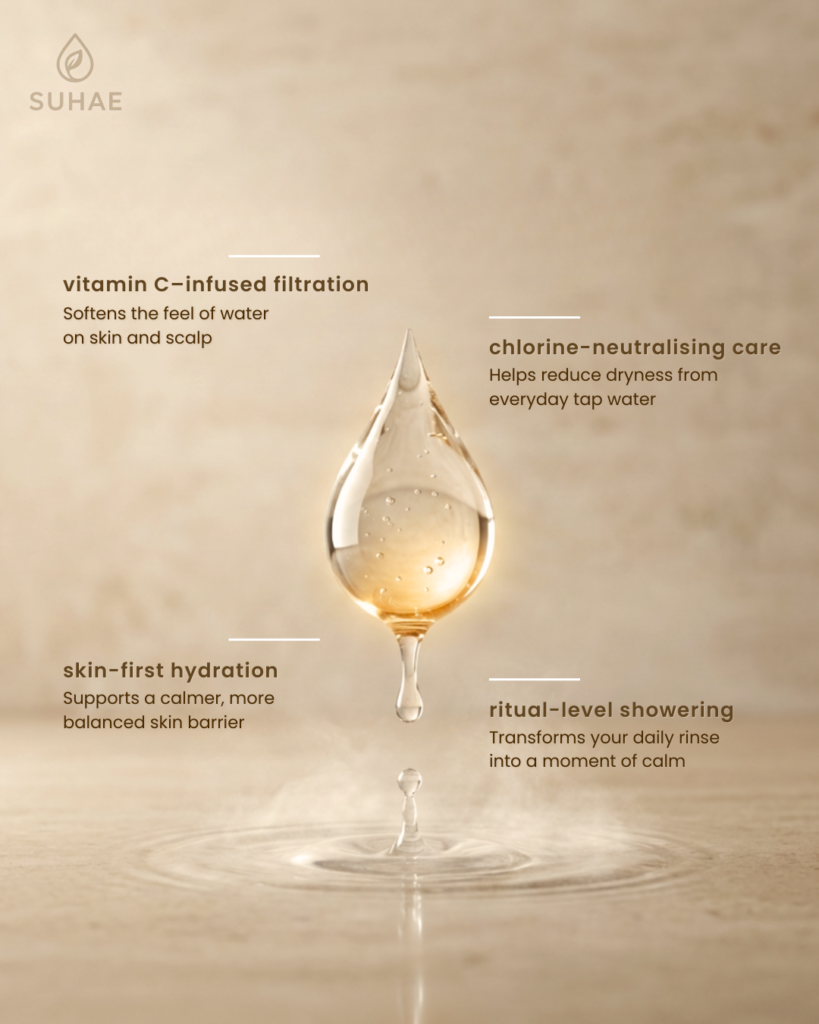
The objection: is this a skincare claim with a vitamin on the label
This is the fair criticism of the whole category and it deserves a direct answer rather than a deflection.
Vitamin C in a serum and vitamin C in a shower cartridge are doing unrelated jobs. In a serum it is formulated at a controlled concentration and pH to stay stable on skin over hours. In a cartridge it is a reducing agent whose entire purpose is to be consumed reacting with chlorine before the water reaches you. Any suggestion that a shower cartridge delivers the benefits of topical vitamin C is a claim the chemistry does not support, and it is not one we are going to make.
The clinical picture on chlorine and skin is also thinner than most marketing implies. Seki and colleagues, in the Journal of Dermatology in 2003, found chlorine at 1.0 and 2.0 mg/L significantly reduced stratum corneum hydration. Their subjects were patients with atopic dermatitis, a group with an already compromised barrier, and extending that finding to the general population would be dishonest.
What is left after subtracting the overclaiming is modest and true. A residual is present. A reaction reduces it. Whether that changes how your skin feels is something you will find out, and there is more honest detail in what the evidence does and does not say about chlorine and skin irritation.
Who this is for, and who it is not for
Reasonable to try if you shower daily or twice daily, if skin feels tight in the ten minutes after towelling off, if the cubicle smells of chlorine when the fan is off, if you have coloured or chemically treated hair, or if you rent and want something reversible that leaves no trace on the plumbing.
Not for you in four cases. If you want better drinking water, this does nothing for the kitchen tap. If your complaint is weak flow, the cause is usually upstream and worth diagnosing first. If you are hoping to treat eczema, psoriasis or persistent scalp irritation, a dermatologist comes before a shower head, and no filter should be sold to you as a treatment. And if you shower two or three times a week, the cumulative-exposure argument this rests on largely evaporates.
One more group worth naming: anyone unwilling to keep up with cartridge replacement. A reactive medium that is not replaced is not a filter, and the 2 to 3 month replacement window is not optional if you want the thing to work.
What vitamin C shower filter Singapore buyers should check
Four things separate the credible options from the rest.
Stated vitamin C content, because a cartridge that does not say how much it holds is telling you something. Fit for local hardware, since HDB and condo bathrooms use standard threads and anything needing an adapter is a nuisance. Refill availability and price, which is the real cost of ownership rather than the sticker. And whether the head does anything about flow, because a cartridge in the line adds resistance that a well-designed spray needs to compensate for.
On the first point, Vitae Infusion states 25,000 mg of vitamin C per cartridge, which helps neutralise the chlorine residual rather than removing everything in the stream. Working alongside it on particulates, the Purea Core runs three-step filtration using SGS-tested materials. On the flow question, Aera Flow uses micro-jet triangular spray holes to raise perceived pressure by up to 50 percent while cutting water use by 30 to 50 percent.
Across the local range, the vitamin C handshower models start at S$99 for the Nourish and S$149 for the Radiance. Keeping hardware you already like, the universal retrofit filter at S$49.90 threads between hose and head. Refills are S$29.90 each or 3 for S$74.90.
What to expect
Week 1 to 2. The change most people report first is the smell of the cubicle, not anything about their skin. Skin impressions this early are unreliable, because you are paying attention in a way you were not before.
Month 1 to 2. If there is a difference in how tight skin feels after drying, this is roughly when it becomes noticeable. Hair lags, since you can only judge new growth and the length you have kept.
Month 3 to 6. The routine is just the routine by now. The honest test is showering somewhere else and noticing the difference in reverse.
Frequently asked questions
Does a vitamin C filter remove all the chlorine?
The SUHAE filter removes 99.9% of chlorine, right at the shower head, in the moment the water passes through the cartridge.
Is there something wrong with Singapore tap water?
No. PUB’s supply meets WHO guideline values and is tested continuously. The narrower point is that safe to drink and optimal for ten minutes of daily skin contact are two different questions.
Does the vitamin C leave a residue on skin or hair?
No. The ascorbic acid is consumed in the reaction with chlorine and what remains washes away with the water.
Will it help with hair colour fading?
Colour treated hair is one of the more plausible cases, though water is only one factor alongside heat, sun and products. The detail sits in how shower water interacts with coloured hair day to day.
Do I need a plumber to fit one?
For a handshower or a retrofit filter, no. Both thread onto the standard hose fitting used in HDB and condo bathrooms and take a few minutes with plumber’s tape. An overhead set is a bigger job.
What does SUHAE cover under warranty?
Functional parts only. Cartridges are consumables and sit outside that, since they are designed to be used up. If you would rather see the spray before buying, the showroom at T-Space, #01-18, 1 Tampines North Drive 1, Singapore 528559 has the models running on live water, or call +65 8988 1336.
References
- PUB, Singapore Drinking Water Quality, January to December 2025. Chlorine average 2.27 mg/L (range 1.43 to 2.87), monochloramine average 2.10 mg/L, total hardness average 42.7 mg/L, pH 8.0.
- PUB, Water Treatment. “Ammonia is added to the treated water to form chloramines, a more stable chlorine residual.”
- Seki T et al., Journal of Dermatology, 2003 (PMID 12692355). Chlorine at 1.0 and 2.0 mg/L and stratum corneum hydration in atopic dermatitis patients.
If the argument holds up for you, start by comparing the two handshower models rather than the marketing around them. The vitamin C shower heads differ mainly in spray design and price, and two months of use will tell you more than any product page can.
