
Water Quality & Chlorine
Why Tap Water Still Contains Chlorine After Treatment and What It Means for Your Daily Routine
Apr
Quick answer: Chlorine in tap water in Singapore is not treatment left unfinished. PUB deliberately keeps a disinfectant residual in the water so it stays protected across the entire distribution network, and it stabilises that residual by adding ammonia to form chloramine. The residual is doing useful work right up to your tap, which is also why you meet it in the shower every morning.
A reasonable assumption sits behind the question. If water has been treated, filtered and tested, surely it should arrive with nothing added to it. The reason it does not comes down to what happens after the water leaves the plant, in a network nobody can sterilise twice.
The residual exists because the pipes are the vulnerable part
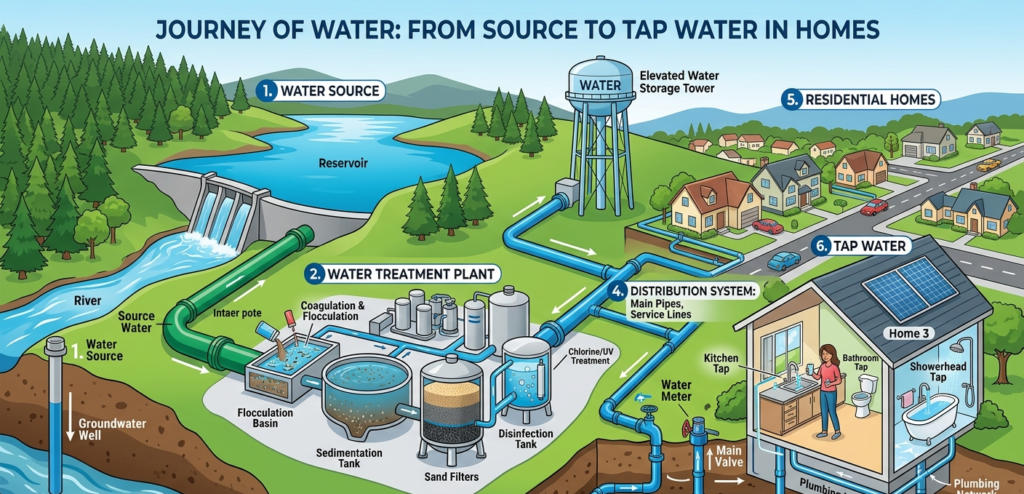
Treatment happens in one place. Consumption happens across an island, hours or sometimes days later, through service reservoirs, mains, riser pipes and a storage tank on your roof. Every metre of that is an opportunity for microbial regrowth, a pressure drop, a repair, a cracked joint.
Disinfect once at the plant and you have clean water at the plant. Carry a residual through the network and you have water that keeps defending itself the whole way. That is the entire argument for residual disinfection, and it is why every developed water utility does it.
PUB is explicit about the method: “Ammonia is added to the treated water to form chloramines, a more stable chlorine residual.” Free chlorine is reactive and fades quickly. Bound to ammonia as monochloramine, it lasts far longer, which is what a long network requires. The trade is a residual with a more persistent character, and it is the reason shower water sometimes carries a strong chlorine smell when the same water at the kitchen tap does not.
What the Singapore numbers actually are
Vague talk about chemicals in the water helps nobody, so here are PUB’s published figures for January to December 2025.
- Total chlorine, average 2.27 mg/L, measured range 1.43 to 2.87 mg/L
- Monochloramine, average 2.10 mg/L
- Total hardness, average 42.7 mg/L
- pH, average 8.0
Two things follow from that list. The first is that most of the chlorine present is bound as chloramine rather than floating free, which changes how it behaves in a hot bathroom. The second is that at 42.7 mg/L, Singapore water is soft. Any local claim that limescale or mineral hardness is drying out your skin does not survive contact with PUB’s own measurements, and we set out what the hardness figures mean in practice separately.
The objection: does residual chlorine mean the treatment failed
It means the opposite. A sample arriving at your flat with no measurable residual would be the finding worth worrying about, because it would suggest the disinfectant had been consumed somewhere along the way by something it had to react with.
Singapore’s supply meets WHO guideline values and is safe to drink from the tap. Nothing on this page argues otherwise, and a brand that tries to talk you out of trusting your tap has stopped being useful to you.
The distinction that does hold is narrower. Drinking water standards describe ingestion, roughly two litres a day passing through a digestive tract built to handle it. They were not designed to describe ten minutes of daily contact between warm chloraminated water and a lipid barrier, which is a different exposure with a different question attached. Safe to drink and optimal for prolonged skin contact are separate propositions, and only the first one has a regulatory answer.
The research is genuinely mixed and we will not overstate it. Seki and colleagues, in the Journal of Dermatology in 2003, reported that chlorinated water at 1.0 and 2.0 mg/L significantly reduced stratum corneum hydration in patients with atopic dermatitis, a population-specific finding that should not be stretched to everyone. Perkin and colleagues in 2016, writing in the Journal of Allergy and Clinical Immunology, concluded that chlorine’s influence remains uncertain.

Who this changes something for, and who it does not
Relevant if you shower twice a day because of the climate, if you have dry or reactive skin that tightens within half an hour of drying off, if anyone in the house has diagnosed eczema, if you colour-treat your hair, or if the smell in an unventilated bathroom bothers you enough to notice it daily.
Not relevant if your skin and hair feel fine. There is no benefit waiting for someone who has no complaint, and buying hardware to solve a problem you do not have is a poor trade. It is also the wrong purchase if what you actually want is better drinking water, since a shower device sits on one outlet and does nothing for the kitchen. The comparison between a shower filter and a whole-home softener is worth reading before spending anything.
What it means for your daily routine
The practical levers are contact time, temperature and air exchange, in that order.
- Shorten the shower. Total exposure is a product of concentration and minutes, and only one of those is under your control for free.
- Turn the temperature down until the water reads warm rather than hot, since heat raises how much chlorine leaves the water as vapour.
- Run the extractor throughout and for a few minutes afterwards.
- Moisturise while the skin is still slightly damp rather than fully dry.
- Skip the folk remedies. Standing water overnight and boiling both underperform against chloramine, as covered in what boiling actually does to chlorine.
Where point-of-use filtration fits
A shower filter is not an argument with PUB. It sits at the last metre of the network, after the residual has finished protecting the water through every pipe between the plant and your bathroom, and it addresses only the part of the journey where the water touches you.
Designed for households that want to keep the shower head they already have, the Universal retrofit filter costs S$49.90 and threads between hose and head, and the universal shower filter range sits here. The Vitae Infusion cartridge inside carries 25,000 mg of vitamin C and helps neutralise chlorine as water passes through. It helps neutralise it. It does not remove all of it, and any product sold to you on that promise is overreaching.
Replacing the head instead brings the Aera Flow spray plate with it, and the vitamin C shower head range runs from the Nourish at S$99 to the Radiance handshower at S$149 and the Aura overhead at S$249. Refills are S$29.90 each or three for S$74.90, lasting two to three months each, and the timing logic is covered in how often a filter needs replacing here.
Frequently asked questions
How much chlorine in tap water in Singapore is normal?
PUB reported a total chlorine average of 2.27 mg/L for 2025, within a measured range of 1.43 to 2.87 mg/L, and a monochloramine average of 2.10 mg/L.
Why is chloramine used instead of plain chlorine?
Because it lasts. Free chlorine dissipates during distribution, while chloramine holds a residual across a long network, which is precisely what PUB describes as the reason ammonia is added.
Can I taste or smell the residual in drinking water?
Some people can, particularly when the water has been sitting in the pipe. Chilling it in the fridge for an hour usually settles the taste without any equipment.
Does the residual vary between estates?
The published range suggests it varies across the network, since distance from the treatment plant and water age in local pipes both influence how much residual is left at the tap.
Will filtering my shower affect the water elsewhere in the flat?
No. A point-of-use device treats only the outlet it is fitted to, so kitchen and basin taps are unchanged.
Does a SUHAE filter reduce water pressure?
The Aera Flow spray plate is engineered around pressure rather than against it, and we looked at the question directly in whether shower filters change pressure in local homes. Warranty covers functional parts only, not labour or transport.
References
- PUB, Water Treatment, on ammonia and chloramine formation. pub.gov.sg
- PUB, Singapore Drinking Water Quality, January to December 2025. pub.gov.sg
- Seki T et al. Journal of Dermatology, 2003. PMID 12692355. pubmed.ncbi.nlm.nih.gov
- Perkin MR et al. Journal of Allergy and Clinical Immunology, 2016. PMID 27241890. pubmed.ncbi.nlm.nih.gov
If the free adjustments have run their course and you would rather not change a shower head that already suits your bathroom, browse the universal filter range and check the thread against your existing hose before you commit.
