
Shower Tips & Lifestyle
How to Tell if Your Shower Filter Is Working
Oct
How to tell if your shower filter is working comes down to one measurement done correctly, plus three checks that need no equipment at all. The measurement is a total chlorine test on the water before and after the filter. A free chlorine test is the common mistake in Singapore, because most of PUB’s residual arrives as combined chlorine and a free chlorine strip reads low whether you filter or not.
Nobody fits a shower filter expecting to audit it afterwards. The thing goes on, the water comes out, and a few weeks later there is no obvious way to know whether the cartridge is still doing its job. Checking it is worth ten minutes, because a shower filter is one of the few things in a bathroom that fails without a visible symptom.
Why a working filter gives you so little to see
Chlorine reaches Singapore showers in a form that is difficult to perceive in the first place. PUB states it plainly: “Ammonia is added to the treated water to form chloramines, a more stable chlorine residual.” Stable is the operative word. In the January to December 2025 water quality report, total chlorine averaged 2.27 mg/L while monochloramine averaged 2.10 mg/L, so most of what reaches your shower head is combined rather than free chlorine.
At that concentration, combined chlorine is colourless and, in a ventilated bathroom, close to odourless. Take it out and the water looks the same and runs at the same rate. A spent cartridge hides it well, since it does not clog, drip or rattle, and it passes water exactly as well as a new one.
The objection: if you cannot feel it, is anything happening?
Reasonable question, and the chemistry is not the uncertain part. Ascorbic acid reacts with chlorine and with chloramine, and that reaction consumes the media as it goes, which is why a cartridge has a service life at all. What is uncertain is how much of it you can detect at home, and the answer there is better than most people assume, provided you buy the right test.
One limit is worth saying out loud. A test reports on chlorine chemistry, not on whether your skin is better off, and the evidence on that second question is narrower than the marketing around it.
Who should test, and who can leave it alone
Testing earns its keep in a few specific situations rather than as a monthly ritual.
- Best for: a first reading on a newly fitted filter, a shared flat where nobody logs the change date, and any cartridge you cannot see into.
- Check first whether you are testing the cartridge or testing the product line. A strip describes the cartridge in your hand on that day, and a weak reading usually means it is due for replacement.
- Check first if you want the number to quantify a skin benefit. It measures chlorine only, so pair it with how your skin feels over a few weeks rather than reading it as a verdict.
How to tell if your shower filter is working: four checks
1. Total chlorine test strips: the only check that measures the thing itself
Buy strips labelled total chlorine. Total chlorine covers the free fraction and the combined fraction together, while a free chlorine strip reads only the free part. Given PUB’s figures above, a free chlorine strip can return an almost blank result on completely unfiltered Singapore tap water, which looks like a flawless filter and proves nothing.
Method. Fill a cup from a tap with no filter on it, then run the shower for thirty seconds and fill a second cup from the stream. Dip a strip in each and read both against the chart in the same light, side by side. The comparison is the result; one reading alone tells you almost nothing.
- Best for: an actual before-and-after number, and for settling an argument about an old cartridge.
- Check first that the tube says total chlorine. The free chlorine version is cheaper and far more common on the shelf, and it is the single reason most home tests of Singapore shower water come out meaningless.
2. The cartridge itself: colour and fill level
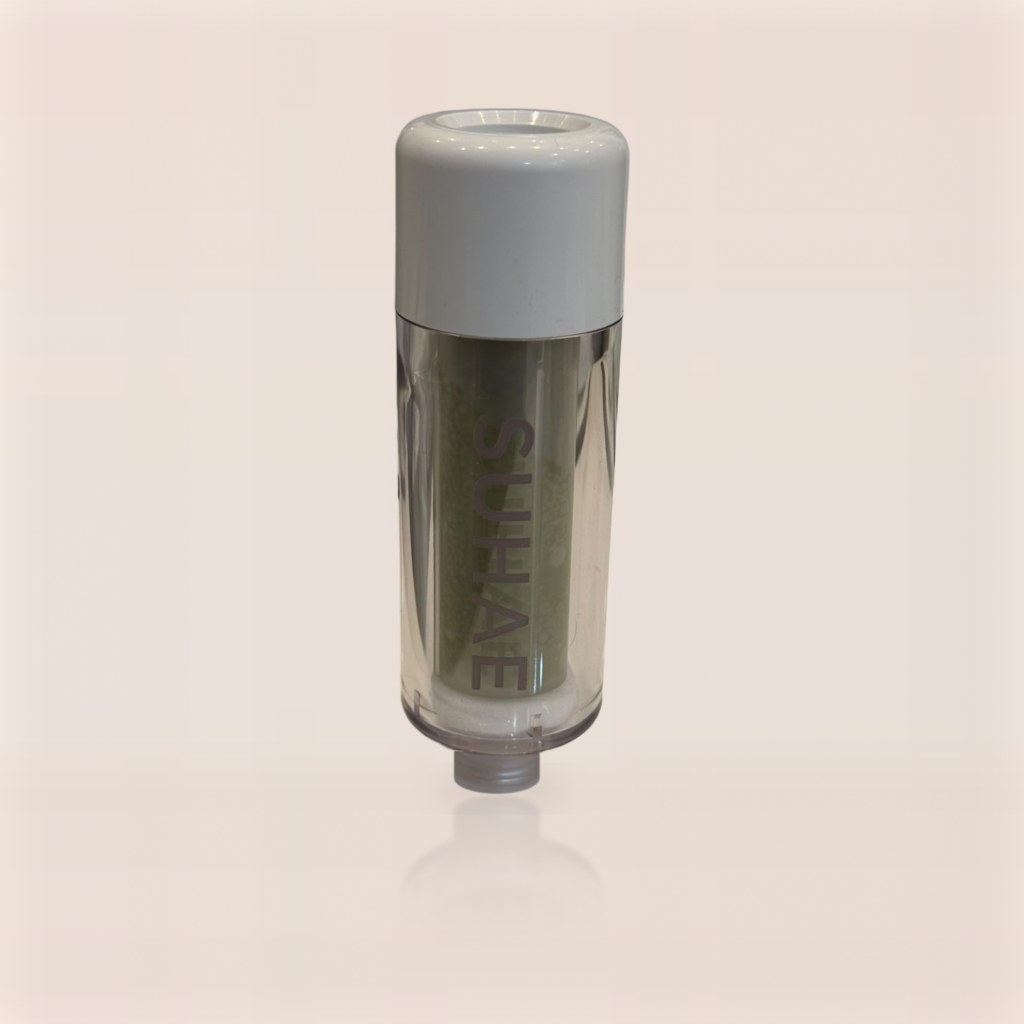
Vitamin C media is consumed as it reacts, so on a clear housing you can watch the fill level drop over a couple of months, and some variants discolour as they go. Treat what you see as a prompt to check the date rather than as a measurement, because the replacement window is covered properly elsewhere.
- Best for: a five-second read with no equipment, on any inline filter with a transparent housing.
- Check first whether your variant shows anything at all. On an opaque cartridge the calendar is the more reliable guide, and a pale cartridge can still have working media in it.
3. Smell at the head, compared against other taps
Smell is a weak instrument, but the comparison between outlets is a strong one. A sharper chlorine note at the shower head than at the basin two feet away points at the cartridge. The same note at every tap at once points at the supply, which is normal and temporary after mains work nearby.
- Best for: telling a cartridge problem apart from a supply-side one, in about a minute, for free.
- Check first that the bathroom has been ventilated. A closed wet room concentrates what little odour there is, and hot water lifts it.
4. Flow rate: useful, but not about filtration
Flow is the check people reach for first and the one that answers a different question. A noticeable drop usually means something physical is blocking the path: soap scum across the face plate, or debris shed by an ageing hose. Neither describes the chemical state of the media. Steady flow and dead media coexist happily.
- Best for: catching a clogged head or a tired hose, both worth fixing on their own terms.
- Check first whether you are expecting flow to report on filtration. It does not, and a properly fitted filter should not cost much pressure anyway.
What to expect across a cartridge’s life
- Week 1 to 2. A fresh cartridge gives the widest gap between the two cups. Photograph both strips next to the chart; that picture is your baseline.
- Month 1 to 2. The gap narrows gradually. Vitamin C refills are rated for two to three months of normal use, and a four-person flat burns through one faster than a couple does.
- Month 3 to 6. The two readings converge. Once the shower cup matches the unfiltered cup, the cartridge is passing water rather than treating it, whatever it looks like in the housing.
Frequently asked questions
Will a free chlorine test strip work in Singapore?
A free chlorine strip measures only the free fraction. PUB’s 2025 figures put total chlorine at an average of 2.27 mg/L against monochloramine at 2.10 mg/L, so the free portion is the small remainder and the strip reads low on unfiltered water too. Total chlorine strips are the ones to buy.
What reading should I expect before the water is filtered?
PUB reported total chlorine across 2025 in a range of 1.43 to 2.87 mg/L, averaging 2.27 mg/L, drawn from over 500,000 tests a year. Home strips read in broad colour bands, so use the unfiltered cup as your reference point.
Does a pale reading mean all the chlorine has gone?
Filtration helps neutralise chlorine rather than removing every trace of it, and a test strip has a detection floor below which it stops changing colour. A pale band is good evidence the cartridge is active, and it is not proof of zero.
Can I tell by how my skin feels?
Skin feel is confounded by too much else to work as a test. Seki and colleagues (2003) found reduced stratum corneum hydration at chlorine levels of 1.0 to 2.0 mg/L, but that was in patients with atopic dermatitis and does not extend to everyone. Water temperature and a night under the aircon move the needle more on any given day.
Could hard water be affecting my test?
Singapore’s supply is soft. PUB’s 2025 average for total hardness is 42.7 mg/L, so hardness is not the variable people arriving from Europe expect. White film in the bathroom here is usually soap scum, a cleaning job rather than a filtration one.
How do I check a SUHAE filter specifically?
Visible through the clear housing, the Vitae refill shows its fill level as the media is used, which makes the two-cup strip test easy to time. Rated at two to three months of normal use, refills are S$29.90 each or three for S$74.90.
References
- PUB, Singapore Drinking Water Quality, January to December 2025: SG-Drinking-Water-Quality.pdf
- PUB, Water Treatment: pub.gov.sg/Public/WaterLoop/Water-Treatment
- PUB, Water Quality: pub.gov.sg/Public/WaterLoop/Water-Quality
- Seki T et al. Effects of chlorinated water on the skin. J Dermatol, 2003. PMID 12692355: pubmed.ncbi.nlm.nih.gov/12692355
Two cups, two strips and a minute of attention will settle the question, and the baseline photo you take in week one is what makes every later test readable. Suitable for a shower head you would rather keep as it is, a universal inline filter sits between the hose and the head and gives you a clean point to measure across. The showroom at T-Space, #01-18, 1 Tampines North Drive 1, Singapore 528559 runs them on mains pressure if you would rather see one first.
