
Water Quality & Chlorine
Why Shower Water Sometimes Has a Strong Chlorine Smell
Apr
Quick answer: The chlorine smell in shower water comes mostly from chloramine, the disinfectant residual PUB deliberately maintains so treated water stays protected all the way to your tap. Heat and droplet spray push it into the air far faster than a running kitchen tap does, and a small enclosed bathroom then traps it. A stronger smell signals better ventilation is needed, not that anything has gone wrong with the water.
The instinctive reading is that something has gone wrong at the treatment plant, or that your building’s tank needs cleaning. Usually neither is true. The smell is the system working as designed, and understanding the chemistry makes it obvious why it shows up in the shower rather than at the sink.
What you are actually smelling
Most people call it chlorine. Chemically it usually is not, or at least not in the form they picture.
PUB describes the step in plain language: “Ammonia is added to the treated water to form chloramines, a more stable chlorine residual.” Free chlorine on its own dissipates as water travels through the distribution network. Bind it to ammonia and you get monochloramine, which survives the journey and keeps working inside kilometres of pipe. For January to December 2025, PUB reported monochloramine averaging 2.10 mg/L, alongside a total chlorine average of 2.27 mg/L with a range of 1.43 to 2.87.
Chloramine is the compound with the pool-changing-room signature. In a swimming pool that same smell forms when free chlorine meets sweat, and a strong pool smell there means the water needs attention. In a domestic supply the chloramine was put in on purpose, which is a different situation entirely. The reason a residual survives treatment at all is worth reading if the distinction feels counterintuitive.
Why the shower concentrates it and the kitchen tap does not
Three things happen at once in a shower, and each one increases how much volatile compound reaches your nose.
First, surface area. A shower head breaks a single stream into a few thousand droplets. Total volume is unchanged, but the water-to-air interface expands enormously, and volatile compounds leave a droplet far more readily than a stream.
Second, heat. Warm water holds dissolved gases less well than cold water. Run the shower at 40 degrees rather than 25 and you accelerate the rate at which chloramine leaves the liquid phase. This is the same mechanism behind the observation that hotter showers raise perceived chlorine exposure.
Third, the room. A typical HDB or condo bathroom is a few cubic metres, often with a single extractor and no window. Whatever comes out of solution stays in that volume for the length of your shower and then some. Fill your kitchen sink with the identical water and you will barely register it, because none of those three amplifiers apply.
Does a strong smell mean something is wrong with the water
No, and it is worth saying that clearly rather than leaving room for doubt. Singapore’s supply meets WHO guideline values, is monitored continuously, and is safe to drink straight from the tap. A noticeable chloramine smell in a warm bathroom is not evidence of contamination. If anything it is evidence the residual is intact and doing its job.
The second half of the objection is more interesting. If the water is safe, why bother reducing the smell at all? Because drinking water standards describe swallowing a couple of litres a day. They were not written to describe standing in an enclosed room inhaling aerosolised disinfectant for ten minutes while your skin is warm, wet and permeable. Safe to drink and pleasant to shower in are separate questions, and only the first one is regulated.
Where the evidence is thin, we will say so. Seki and colleagues, in the Journal of Dermatology in 2003, found that chlorinated water at 1.0 and 2.0 mg/L significantly reduced stratum corneum hydration in patients with atopic dermatitis. That finding applies to that group and should not be generalised. Perkin and colleagues, writing in the Journal of Allergy and Clinical Immunology in 2016, concluded that chlorine’s influence on eczema risk remains uncertain. Uncertain is the honest word.
Who should act on this, and who can leave it alone
Worth addressing if the smell is strong enough that you cut showers short, if anyone in the household has asthma or a respiratory sensitivity that flares in steam, if you have eczema-prone skin, if your bathroom has no window and a weak extractor, or if you simply find the scent unpleasant enough to think about it daily.
Not worth spending on if you only notice it occasionally, if the smell appeared suddenly after works in your block, or if a metallic or musty note is present rather than a pool note. A sudden change points at the plumbing, not the treatment, and the right first call is your building management or PUB. A filter will not diagnose a pipe problem for you. The list of signs that point to chlorine rather than something else is useful for telling those apart.
What actually reduces the smell, cheapest first
- Run the extractor fan for the whole shower and five minutes after, not just while you are in there. Air exchange is the single largest lever and it costs nothing.
- Open the door slightly at the end. Even a small pressure gradient clears a bathroom faster than a closed room with a fan.
- Lower the temperature a few degrees. Less volatilisation, less odour, and less demand on your skin barrier at the same time.
- Let the first ten seconds run before you step in, especially after the shower has stood unused overnight.
- Treat the water at the point of use, which is why vitamin C cartridges have gained ground locally.
Boiling gets suggested a lot and does not help here, partly for the obvious practical reason and partly because chloramine is considerably more stubborn than free chlorine. We covered that in a piece on what boiling does and does not do to chlorine.
Where point-of-use filtration fits
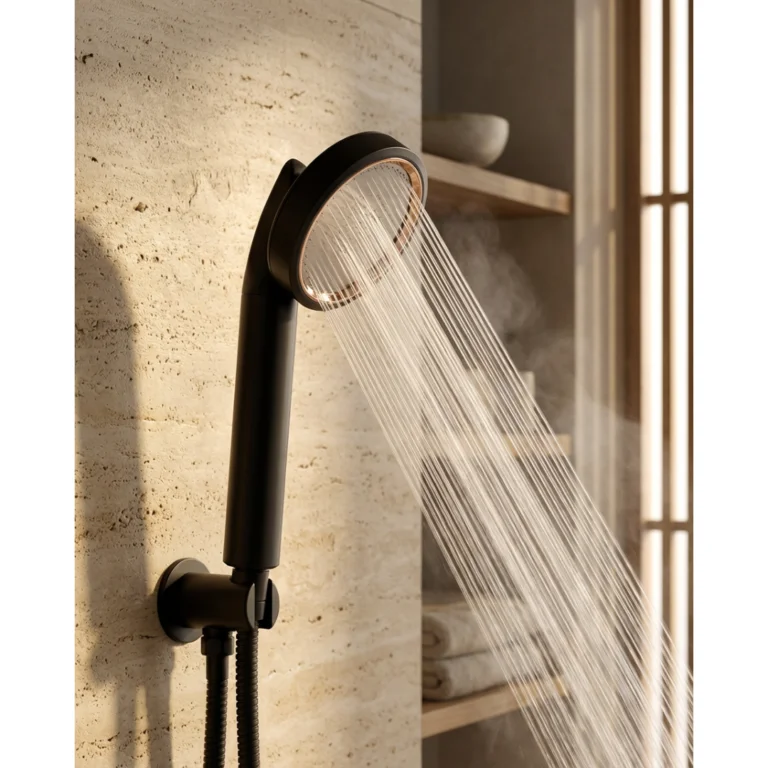
Treating water at the head is the only intervention that changes the water rather than the air around it. Built for households that want to keep their existing fitting, the Universal retrofit filter costs S$49.90 and installs between hose and shower head in a couple of minutes, and the full universal shower filter range is here. Inside it, the Vitae Infusion cartridge carries 25,000 mg of vitamin C and helps neutralise the chlorine residual as water passes through. It helps neutralise. It does not remove all of it, and a claim that it did would be a claim we could not stand behind.
If you would rather replace the head and gain the Aera Flow spray plate at the same time, the vitamin C shower head range runs from the Nourish at S$99 to the Radiance handshower at S$149 and the Aura overhead at S$249. Vitae refills are S$29.90 each or three for S$74.90, and each lasts two to three months. Pressure is the usual worry with any inline device, and we tested that question in whether shower filters change water pressure in local homes. If you want to know what a cartridge is made of before buying one, the breakdown of ingredients used in modern shower filters covers it.
Frequently asked questions
Why does my shower smell like a swimming pool but my drinking water does not?
Same water, different physics. Spray droplets, heat and an enclosed room all push volatile chloramine into the air, and none of those apply when you fill a glass at the sink.
Is the chlorine smell in shower water dangerous to breathe?
Singapore’s supply meets WHO guideline values and normal household showering is not considered a hazard. Anyone with a diagnosed respiratory condition should raise persistent symptoms with a doctor rather than treating it as a plumbing question.
Why is the smell stronger some days than others?
PUB’s reported chlorine range runs from 1.43 to 2.87 mg/L, so the residual genuinely varies. Water age in your building’s pipes, ambient temperature and how long the line sat unused all contribute.
Does an exhaust fan really make a difference?
It makes the largest difference of any free measure, because the problem is concentration in a small volume of air rather than the quantity in the water.
If the smell disappears, has the water stopped being disinfected?
Not at your tap. A filter acts at the point of use, at the very end of the distribution network, so the residual has already done its work protecting the water through the pipes. What a cartridge does and does not catch is set out in what a shower filter actually removes.
How quickly would a SUHAE filter change the smell?
Most people notice a difference in the first few showers, since odour is the most immediate thing to shift. Warranty covers functional parts only and does not extend to labour or transport.
References
- PUB, Water Treatment, on ammonia and chloramine formation. pub.gov.sg
- PUB, Singapore Drinking Water Quality, January to December 2025. pub.gov.sg
- Seki T et al. Journal of Dermatology, 2003. PMID 12692355. pubmed.ncbi.nlm.nih.gov
- Perkin MR et al. Journal of Allergy and Clinical Immunology, 2016. PMID 27241890. pubmed.ncbi.nlm.nih.gov
If ventilation has not fixed it and you would rather not replace a shower head you already like, the retrofit filter is the smallest change that touches the water itself. Have a look at the universal filter range and check it against your hose fitting before deciding.
