
Buying Guides
Is a Shower Filter Worth It in Singapore? Here’s What You Should Know
May
Quick answer: A shower filter is worth it in Singapore for a fairly narrow group: people whose skin runs dry or reactive, people with colour-treated hair, and households in older blocks where the pipework adds sediment. For everyone else it is an optional comfort purchase, not a necessity, because the water arriving at your tap is already safe, already tested, and already soft.
You have probably already tried the usual fixes. A richer moisturiser, a gentler body wash, shorter showers. If none of that shifted anything, the water itself becomes a fair thing to question. What follows is the arithmetic and the evidence, including the cases where the honest answer is no.
What you are actually paying to change
PUB’s own testing for January to December 2025 puts free chlorine at an average of 2.27 mg/L, ranging from 1.43 to 2.87 mg/L across the network. Monochloramine averaged 2.10 mg/L. That second number exists because, as PUB describes it, “Ammonia is added to the treated water to form chloramines, a more stable chlorine residual.” The residual is deliberate and it is there for good public health reasons.
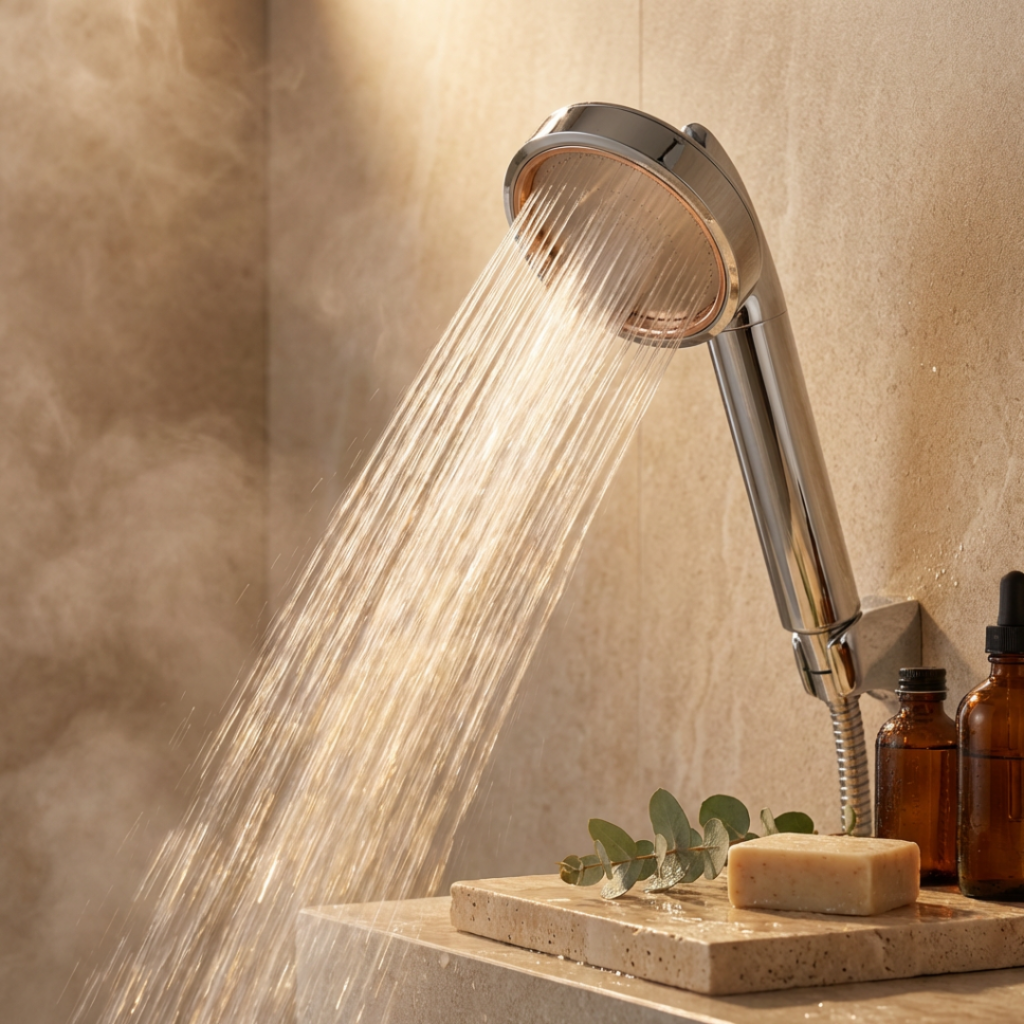
A shower filter reduces some portion of that residual at the point of use, and traps fine sediment picked up between the treatment works and your bathroom. That is the whole product. If you want the itemised version, we covered what a shower filter genuinely removes and what it does not in detail.
One thing it does not change is hardness. Total hardness averaged 42.7 mg/L in the same report, which classifies as soft water. Overseas marketing about limescale, mineral buildup on hair and dull soap lather is written for cities with three or four times that figure. If you have seen the hard water pitch applied locally, the comparison between Singapore’s supply and genuinely hard water is worth five minutes before you spend anything.
The arithmetic, plainly
Sceptical readers deserve numbers rather than adjectives. A universal retrofit filter costs S$49.90 up front. Refills run S$29.90 each, or three for S$74.90. Each refill lasts two to three months in a household showering daily, so a year is roughly four to six refills.
That works out to somewhere between S$100 and S$150 a year in consumables, or about S$8 to S$12 a month. Cheaper than most serum habits. More expensive than doing nothing. The upfront hardware is the small part of the cost, which is the opposite of how most people assume it works, and it is the reason the replacement schedule matters more than the initial purchase. A filter left in for eight months is an ornament.
The objection, taken seriously: our water is already excellent
It is, and pretending otherwise would be dishonest. Singapore tap water meets WHO guidelines, is safe to drink unfiltered, and is tested continuously with the results published. Any brand implying your tap is a hazard has lost the argument before it starts.
The defensible position is a smaller one. Safe to drink is not the same as optimal for ten minutes of daily skin contact. Drinking water spends seconds in your mouth. Shower water sits on your skin at 40 degrees, often twice a day in this climate, for years.
Even then, the research base is modest and should be quoted carefully. Seki and colleagues, in the Journal of Dermatology in 2003, showed that chlorinated water at 1.0 and 2.0 mg/L significantly reduced stratum corneum hydration in patients with atopic dermatitis. That is a specific population, and the finding does not automatically transfer to skin without that condition. Perkin and colleagues, writing in the Journal of Allergy and Clinical Immunology in 2016, looked at water hardness and eczema in infancy and stated that chlorine’s influence remains uncertain. Anyone quoting either paper as proof that everyone needs a filter is stretching it.
Who should skip this entirely
Skip it if your skin and hair are fine. This is the largest group, and there is no polite way to dress it up: if you step out of the shower comfortable, your hair behaves, and nothing itches, a filter is solving a problem you do not have. No amount of water chemistry changes that.
Skip it if you are renting short term and cannot take the fitting with you when you move.
Skip it if the problem you are trying to fix is limescale on the screen or crusting around the tap. At 42.7 mg/L that is usually soap residue rather than mineral scale, and a squeegee costs less than a year of refills. The full comparison between a shower filter and a water softener explains why softening equipment rarely earns its keep here.
Skip it if you will not keep up with refills. A filter is a subscription in disguise. If the idea of reordering every couple of months irritates you, you will end up running spent media and concluding the category does not work.
Most importantly, skip it as a first move if you have a diagnosed skin condition, persistent scalp irritation, or hair coming out in noticeable quantity. Those belong with a doctor. Filtration is a comfort measure and nothing in the evidence supports treating it as therapy.
Who tends to conclude it was worth the money
People with dry or reactive skin who already know they react to pool water. If chlorinated swimming leaves your skin tight for hours, daily chlorinated showering is the same exposure at lower concentration and much higher frequency, which is the mechanism behind how chlorine contact relates to skin irritation.
People with colour-treated hair. Fade is the most visible and most measurable complaint, and it is one you can actually track between salon visits rather than guess at. The same logic runs through what colour-treated hair needs from shower water.
Households in older resale blocks, where sediment from ageing pipework is visible in the basin after a supply interruption. Here the mechanical stage does something you can see on the cartridge.
And anyone who can smell chlorine in the cubicle on a hot afternoon. That is the one change a filter delivers immediately and unambiguously.
How to test it without wasting money
Start with the cheapest format. A retrofit unit screws in between your existing hose and shower head, fits standard HDB and condo threads, and needs no plumber. Priced at S$49.90, the universal filter range exists precisely so you can find out whether filtration does anything for you before committing to a full shower system.
Then judge it properly. Weeks one and two, the only reliable signal is smell. Month one to two is where skin and hair feedback shows up, if it shows up at all. By month three you will know. Change one thing at a time, or you will not be able to tell what worked.
Built around the same reasoning, the Vitae Infusion refill carries 25,000 mg of vitamin C that helps neutralise chlorine as water passes through, and Purea Core handles the mechanical stages. Refills are S$29.90 each or three for S$74.90.
Frequently asked questions
Is Singapore water hard enough to need a filter?
No. Total hardness averaged 42.7 mg/L in PUB’s 2025 report, which is soft. The case for filtration here rests on chlorine and chloramine contact, not on minerals.
Does a filter make tap water safer to drink?
It is not designed for that and it is not needed for that. Local tap water is already safe to drink. A shower filter addresses skin and hair contact, which is a comfort question rather than a safety one.
How long before I notice anything?
The chlorine smell usually goes on the first shower. Anything to do with how skin or hair feels takes several weeks, and some people never notice a difference at all. That outcome is worth planning for before you buy.
Will it weaken my water pressure?
A fresh cartridge adds very little resistance. An overdue one does, which is the most common cause of complaints, and the relationship between filters and shower pressure is worth understanding before you install anything.
Can it help with eczema?
That question belongs to a dermatologist. The one relevant study looked at stratum corneum hydration in patients already diagnosed with atopic dermatitis, and it does not amount to evidence that filtration treats the condition. Nobody should be selling you one on that basis.
What is SUHAE’s warranty position?
Cover applies to functional parts only. Labour and transport are not included, and refills are consumables rather than warranty items. Worth knowing up front rather than at the point of a claim.
References
- PUB Singapore, Drinking Water Quality, January to December 2025. Chlorine, chloramine and hardness figures
- PUB Singapore, Water Treatment. Why ammonia is added to form chloramines
- Seki T et al., Journal of Dermatology, 2003. Chlorine and skin hydration in atopic dermatitis, PubMed 12692355
- Perkin MR et al., Journal of Allergy and Clinical Immunology, 2016. Water hardness, chlorine and eczema in infancy, PubMed 27241890
If you landed in the group this actually suits, test it the cheap way first. Fit a S$49.90 retrofit unit to the shower head you already own, keep the refills current, and give it three months before you decide. Have a look at the universal shower filter options when you are ready.
