
Buying Guides
Shower Filter vs Water Softener in Singapore: Which Is Better for Your Home?
Jun
Quick answer: In the shower filter vs water softener question, a Singapore home almost always wants the filter. PUB’s own 2025 testing puts total hardness at an average of 42.7 mg/L, which sits well inside the soft range, so a softener spends money solving a problem most local households do not have. What is measurably present at the tap is a chloramine residual averaging 2.10 mg/L, and that is the thing a shower filter is built to address.
This comparison gets imported wholesale from American and British home improvement content, where hard water is a real and expensive nuisance. Singapore is not that market. The two devices solve two different problems, and only one of those problems is common here.
What a water softener does, and the single number that settles it
A water softener removes calcium and magnesium through ion exchange, swapping them for sodium or potassium. It is plumbed into the main supply, it treats the whole house, and it needs periodic salt top-ups and a drain line for regeneration. Where groundwater runs through limestone it earns its keep: less scale, longer heater life, soap that lathers.
Whether it is worth installing comes down to one measurement. Water below roughly 60 mg/L of calcium carbonate is conventionally classed as soft. PUB’s Singapore Drinking Water Quality report for January to December 2025 gives a total hardness average of 42.7 mg/L. That is not borderline. It is comfortably soft, and it is why you have probably never descaled a shower head in this country.
One honest caveat. PUB reports a range of 7.24 to 191 mg/L across all samples, so individual readings do land higher, particularly where a building’s own storage and pipework play a part. The average is what your tap most likely delivers, but if you genuinely see chalky white scale accumulating on glass and taps, get the water tested before assuming. A fuller reading of what PUB’s hardness numbers actually mean for a local household covers that range in more detail.
What is actually in Singapore shower water
Minerals are not the story here. Disinfectant residual is.
PUB describes the step plainly: “Ammonia is added to the treated water to form chloramines, a more stable chlorine residual.” That stability is the entire point. A residual that breaks down quickly protects the water for a short distance; a chloramine residual keeps working all the way through the distribution network to a fourteenth floor bathroom. The 2025 figures put free chlorine at an average of 2.27 mg/L, ranging 1.43 to 2.87, and monochloramine at an average of 2.10 mg/L. pH averages 8.0.
Those numbers are a sign the system is working as designed, not a failure. They also mean that when you stand under the shower, the water on your skin carries a designed-in disinfectant residual, twice a day in most Singapore households, because the climate makes it so. Contact time is the variable nobody prices in.
Installed at the shower arm, a filter works only during those minutes and treats only that water. Nothing is plumbed into the riser, no salt is stored, no drain line is cut. If you want the granular version of what a cartridge does and does not catch, the breakdown of what a shower filter genuinely removes is more specific than most product pages.
The objection: so you are saying Singapore tap water is bad
No. That framing is where most shower filter marketing goes wrong, and it deserves to be called out even when the company doing the calling sells filters.
Singapore’s water meets WHO guideline values, PUB runs an accredited testing programme, and there is no honest case for suggesting otherwise. Any brand that needs you to distrust your tap in order to make a sale is telling you something about the brand, not about the water.
The narrower position is the defensible one. Safe to drink is not the same question as optimal for ten minutes of daily skin contact. The clinical evidence on that second question is thinner than most marketing pretends: Seki and colleagues, writing in the Journal of Dermatology in 2003, found chlorine at 1.0 and 2.0 mg/L significantly reduced stratum corneum hydration, but their subjects were atopic dermatitis patients. That does not generalise to everyone, and we will not claim it does. What remains true regardless is that the residual is there, contact is daily, and reducing it is cheap and reversible if you decide you do not notice a difference.
Who this is for, and who it is not for
A shower filter is worth considering if you shower daily or twice daily, if skin feels tight in the minutes after towelling off, if you notice the chlorine smell building in an unventilated cubicle, if you have coloured or chemically treated hair, or if you rent and cannot modify plumbing.
It is the wrong purchase in several situations. If you want treated drinking water, buy a tap or countertop filter instead; a shower filter does nothing for what you drink. If your complaint is weak flow, diagnose that first, because adding a cartridge to an already weak line is the wrong direction. If you have a diagnosed skin condition, a dermatologist comes before a shower head. And if you are chasing scale on the glass, that is usually soap scum or silica rather than hardness, and neither device fixes it.
A water softener earns its place in a Singapore home in exactly one scenario worth naming: a property drawing on a private or non-PUB supply, or a building with unusual storage arrangements, where testing has actually confirmed higher hardness. Testing first. Not the other way round.
Shower filter vs water softener on cost and installation
A whole-house softener is a plumbing project. It needs a unit, a bypass valve, a drain connection and space in a service area, which is already awkward in most HDB and condo layouts, plus ongoing salt. That is before you have addressed a single milligram of chloramine, because ion exchange does not touch it.
Point-of-use filtration runs at a different order of magnitude. Threading onto the hose fitting already in your bathroom, the universal retrofit filter fits shower hardware you already own at S$49.90, which keeps the head you like. For an existing rainshower arm, the Vitae-Connector housing covers S$69.90 to S$99. Full handshowers start at S$99 for the Nourish and S$149 for the Radiance, with the Aura overhead at S$249.
Running cost is the part people forget. Each Vitae refill lasts 2 to 3 months at S$29.90, or 3 for S$74.90. The actual monthly running cost depends on how quickly your household uses each cartridge. Whether that is good value is yours to judge.
How the filtration itself works
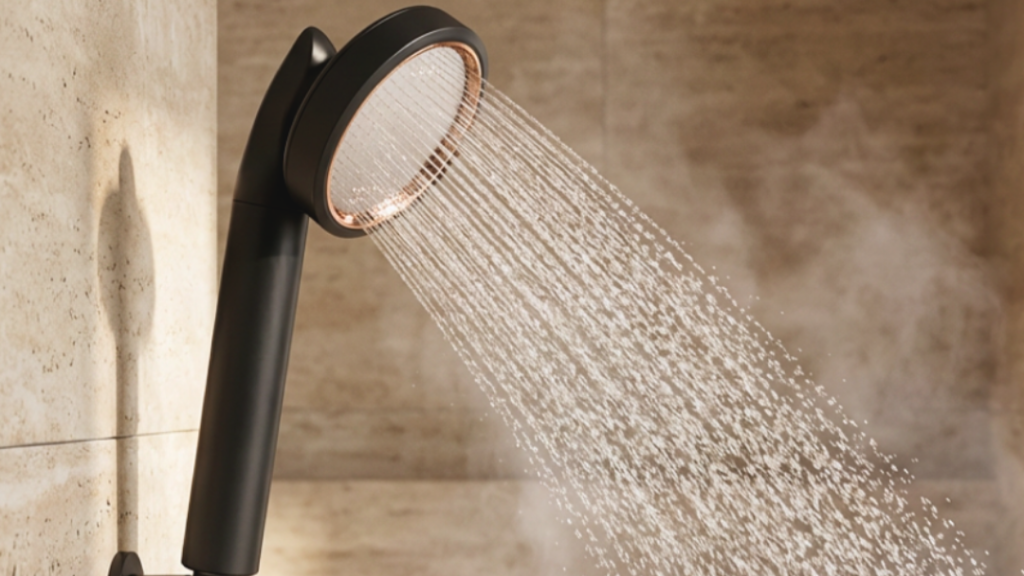
Two mechanisms run in sequence. Reacting with the chlorine residual as water passes through, the 25,000 mg of vitamin C in a Vitae cartridge helps neutralise it. The reaction is fast, which matters, because water spends a fraction of a second inside the housing. Sitting alongside it, the Purea Core handles three-step particulate filtration with SGS-tested materials.
Helps neutralise is the accurate phrase, and it is chosen deliberately. No cartridge at shower flow rates removes everything, and any brand claiming it does is overreaching.
Frequently asked questions
Does Singapore have hard water?
No. PUB’s 2025 average total hardness is 42.7 mg/L, which is soft by any standard classification. Marketing that says otherwise is recycled from overseas.
Can a water softener remove chlorine?
Not in any meaningful way. Ion exchange resin targets calcium and magnesium ions. Some whole-house systems bolt on a separate carbon stage for chlorine, but that is an added component, not the softener doing the work.
Is chloramine harder to filter than free chlorine?
It is more stable, which is why PUB uses it, and that stability means contact time inside a cartridge matters more. It is one reason a reactive medium is used at shower flow rates rather than relying on adsorption alone, and the trade-offs between the different media used in shower cartridges follow from that.
Will a shower filter help with limescale on my screen?
Probably not. In a Singapore bathroom that film is usually soap scum rather than mineral scale, and a squeegee will do more than either device.
Do I need one if I only shower once a day?
Less of a case, since the argument rests on cumulative contact time. Whether the maths works for you is worth reading through in the longer piece on whether the spend justifies itself for an average household.
Can I keep my existing shower head and just add SUHAE filtration?
Yes, and it is the sensible starting point if you like the head you have. The universal retrofit at S$49.90 sits between the hose and the head on standard HDB and condo fittings. Warranty covers functional parts only; cartridges are consumables by design.
References
- PUB, Singapore Drinking Water Quality, January to December 2025. Total hardness average 42.7 mg/L (range 7.24 to 191), chlorine average 2.27 mg/L (range 1.43 to 2.87), monochloramine average 2.10 mg/L, pH 8.0.
- PUB, Water Treatment. “Ammonia is added to the treated water to form chloramines, a more stable chlorine residual.”
- US Department of Energy, Purchasing and Maintaining a Water Softener. On ion exchange and whole-house installation.
- Seki T et al., Journal of Dermatology, 2003 (PMID 12692355). Chlorine at 1.0 and 2.0 mg/L and stratum corneum hydration in atopic dermatitis patients.
If the numbers above have settled the question for you, the cheapest way to test the conclusion is to keep your current shower head and put a cartridge behind it. Have a look at the universal fit filters and give it two months before you decide whether it was worth it.
