
Shower Tips & Lifestyle
Negative Ion Shower Heads: What the Science Actually Supports
Aug
Quick answer: A negative ion shower head does generate negative ions, and the physics behind that is old and uncontroversial. What the evidence does not support is the wellness promise attached to it. Choose a head on spray design and filtration, and treat the ion figure as a side effect of good engineering rather than a reason to buy.
Ion counts are a strange thing to print on a box. Most shower listings in Singapore now carry a number in the hundreds of thousands, with no note on how it was measured or what it does for the person under the water. That gap between a precise figure and a vague promise is worth closing, because the physics underneath is real even where the health claims are not.
Where a negative ion shower head gets its ions
The mechanism is not invented for marketing. When a drop of water breaks apart in moving air, the electric charge inside it separates, and the resulting fragments do not carry that charge evenly. The American Meteorological Society calls this the Lenard effect, defined as “the separation of electric charges accompanying the aerodynamic breakup of water drops”, first studied by the physicist P. Lenard in 1892. It also goes by spray electrification, or the waterfall effect.
The direction of that split matters. By the same definition, the largest fragments carry positive charges, while the fine spray carried off in the air current carries a net negative charge. Any shower that atomises water into fine mist therefore generates negative ions in the air around it, for the same reason waterfalls and sea spray do.
A head with small, high-velocity outlets makes more fine droplets than a wide, slow one, so it generates more ions. That is the entire mechanism: droplet size and air movement, nothing more exotic.
The part the marketing tends to skip
Generating ions and those ions doing something measurable for you are two different claims. The first is settled physics. The second is where most listings quietly overreach. A 2013 review and meta-analysis in BMC Psychiatry pooled the controlled trials on air ionisation and reported no consistent influence of positive or negative air ionisation on anxiety, mood, relaxation, sleep or personal comfort. Those trials used dedicated ion generators under controlled conditions, a far more deliberate setup than ten minutes in a bathroom. Where an effect does not appear consistently in a laboratory, a shower is not where it will suddenly turn up.
So there is no health claim on this page, and be wary of pages that make one. The reason to pick one head over another has to rest on something you can verify at the tap.
What actually changes how a shower feels
Droplet size and velocity do most of the work. Narrow outlets accelerate the same volume of water, so the spray lands with more perceived force even when the flow rate falls. Notice what that means: the design choice that makes a spray feel stronger also makes more fine droplets, and therefore more ions. The figure travels alongside a better spray rather than causing it. If low pressure is what bothers you, the fixes are in our notes on getting more force out of an existing bathroom, and the same principle lets a good head cut water use without feeling weaker.
Water chemistry does the rest, and in Singapore that means chlorine rather than hardness. PUB’s Drinking Water Quality report for January to December 2025 puts average free chlorine at 2.27 mg/L and monochloramine at 2.10 mg/L. Total hardness averages 42.7 mg/L, which classifies as soft, so the hard water story told about other cities does not apply here. Singapore’s tap water meets WHO guidelines and is safe to drink. Safe to drink is not the same as optimal for ten minutes of daily skin contact, and that distinction is the honest case for filtering a shower. The gap between those figures is explained in our piece on why the residual in your pipes is not what leaves the plant.
Who this is and is not for
Worth considering if you are replacing a head anyway, at BTO handover, during a resale reno, or when a hose goes. Worth it too if your bathroom runs at low perceived pressure, or if daily showering in a humid climate means skin and hair spend real time in chlorinated water. A fuller checklist sits in our guide to the features that separate a good head from a cheap one.
Buy one for the spray and the filtration, which are measurable. The ion-driven mood effect is the one thing the evidence does not back. The upgrade earns its place when pressure or water quality already bothers you. If neither does, there is no hurry. A head is a small upgrade with a real but bounded effect.
How the options compare
1. Aera Flow handshowers: the spray design that the ion count is really measuring
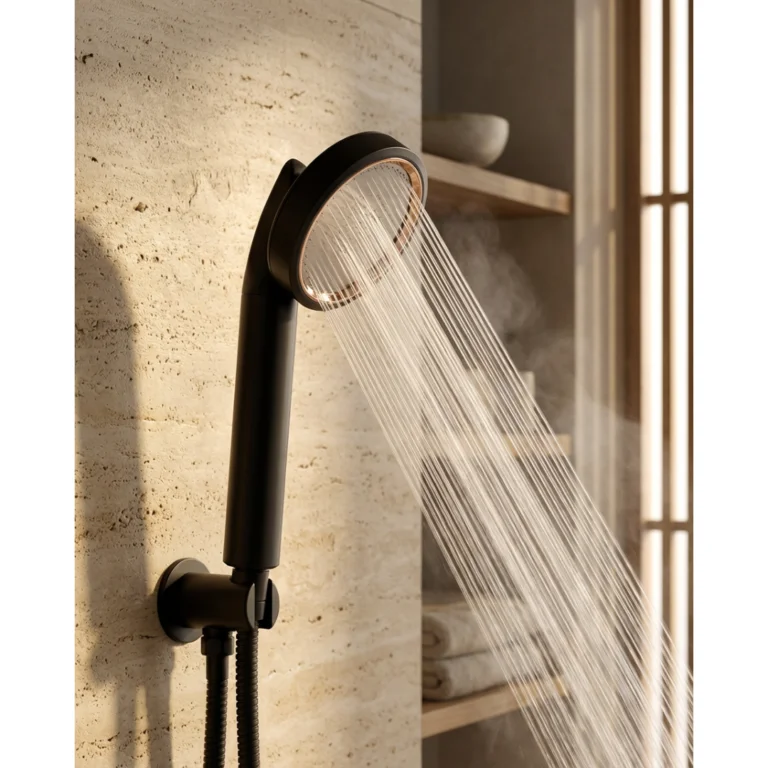
Built around triangular micro-jet spray holes, the Aera Flow head is specified by SUHAE at up to 50% stronger perceived pressure, 30% to 50% water savings, and 400,000 negative ions per cubic centimetre. Read that last number for what it is: a measure of how finely the head atomises water, quoted by us rather than an independent lab, and not a health claim. Priced at S$149, the Radiance ships with one Vitae refill, and the Nourish sits at S$99.
- Best for replacing a tired head, and bathrooms where perceived pressure is the complaint.
- Skip if your head is new, or you would rather not change the fitting.
2. Universal retrofit filters: keeping the head you already have
Sitting inline between the hose and the head you own, the universal retrofit at S$49.90 addresses chemistry without touching spray design. It will not change your ion count, since that is a function of the head itself. Fitment across HDB and condo bathrooms is universal, and the retrofit filter options are the cheapest way in.
- Best for renters, and anyone happy with their spray.
- Skip if low pressure is the real problem, which a filter will not solve.
3. Overhead rain sets: coverage rather than concentrated force
Designed for wide, even coverage, the Aura overhead at S$249 trades the concentrated force of a handheld for a broader fall of water. Larger, slower droplets mean fewer fine ones, so an overhead generates fewer negative ions than a micro-jet handshower at the same flow. Whether that matters is covered in our look at which format suits an HDB bathroom.
- Best for renovations with the plumbing already open.
- Skip if you rent, or need a handheld for rinsing and cleaning.
What to expect
Week 1 to 2. The spray change registers on first use, because perceived pressure is mechanical. Any change in how skin and hair feel is gradual, and easy to over-read this early.
Month 1 to 2. A Vitae refill runs 2 to 3 months in daily use, so this is where filtration does its steadiest work. Our write-up on what a vitamin C head can and cannot do sets a realistic bar.
Month 3 to 6. Refills need replacing on schedule or the filtration stops meaning anything, which is how most people end up disappointed. Habits matter as much by now, several of which sit in our notes on making a daily shower feel better in a humid climate.
Frequently asked questions
Do negative ion shower heads actually produce negative ions? Yes. Any shower that breaks water into fine droplets produces them through the Lenard effect. The physics is not in dispute.
Will negative ions from a shower improve my mood or sleep? The pooled evidence does not support that. A 2013 meta-analysis found no consistent influence of air ionisation on anxiety, mood, relaxation, sleep or personal comfort, using exposures far stronger than a shower.
Is a higher ion number better? A higher number mostly tells you the head atomises water more finely, which usually means a spray that feels stronger. Treat it as a proxy for spray design, not as a benefit in itself.
Do negative ions filter the water? No. Ion generation happens in the air after water leaves the head. Chlorine is the job of the filter cartridge, a separate part of the product.
Does Singapore’s water quality make this more or less relevant? Less relevant on hardness, since PUB’s average total hardness of 42.7 mg/L classifies as soft. More relevant on contact time, because a warm climate means most households shower daily.
Which SUHAE head produces the most negative ions? The Aera Flow handshowers, because triangular micro-jet holes make finer droplets than a wide overhead spray. Compare them across the vitamin C shower head range, though we would rather you chose on spray and filtration.
References
- American Meteorological Society, Glossary of Meteorology, “Lenard effect”. glossary.ametsoc.org/wiki/lenard-effect
- Perez V, Alexander DD, Bailey WH. Air ions and mood outcomes: a review and meta-analysis. BMC Psychiatry 2013. PMID 23320516. pubmed.ncbi.nlm.nih.gov/23320516
- PUB, Singapore Drinking Water Quality, January to December 2025. pub.gov.sg drinking water quality report
If the ion count is what brought you here, the takeaway is that it is a clue rather than a feature: it tells you the head makes fine, fast droplets, and that is what you will feel. Worth comparing the handshowers on spray pattern and refill cost, and letting the ion figure be the footnote it deserves to be. Refills are stocked separately at S$29.90 each, or three for S$74.90 on the refill product page.
