
Buying Guides
Korean Shower Filter: What to Check Before You Buy
Sep
A Korean shower filter is a shower filter designed and made in South Korea, where filtered showering became an ordinary household habit earlier than it did here. The country of manufacture tells you where the unit was built. What it does not tell you is what the cartridge contains or what it will cost you to keep feeding it, and those are the two things that decide whether the purchase was worth making.
Most people reach this search after watching a Korean skincare video and wondering whether the Korea part is real or decorative. It is a fair thing to wonder about. Country of origin is one of the few specifications a buyer can check in two seconds, which is exactly why it gets used as shorthand for quality, and shorthand is usually where the money goes wrong.
What is actually in the water here
Before checking any product, it helps to know what the filter has to deal with. PUB publishes its own drinking water quality figures every year, and the 2025 report gives a national average of 2.10 mg/L monochloramine and 2.27 mg/L total chlorine. PUB also states plainly on its water treatment page that “ammonia is added to the treated water to form chloramines, a more stable chlorine residual”. Stable is the operative word. Chloramine holds its residual for longer than free chlorine does, which is good for a distribution network and less convenient for anyone standing under it every evening.
The other number is the one that quietly rules out half the filters on the market. Total hardness here averages 42.7 mg/L, which sits in the soft range. Singapore does not have a limescale problem, so a cartridge built around softening resin is solving something that is not happening in your bathroom. We went through the numbers in more detail in our piece on whether Singapore water counts as hard or soft, and the short version is that it does not.
So the honest framing for this market is narrow. Safe to drink is not the same thing as ideal for ten minutes of daily skin contact, and the difference between chloramine and free chlorine is the whole reason a Korean shower filter sold into this market has to be judged on its media rather than on its marketing. We set out what a shower filter can and cannot remove separately.
What “Made in Korea” does and does not tell you
It tells you where the housing was moulded and where the unit was assembled. Korean manufacturing for this category is mature, thread sizes are consistent, and cartridge formats are standardised enough that refills are easy to source. Those are real advantages and they are worth something.
What it does not tell you is the part that matters. Origin says nothing about which media are packed inside, how much contact time the water gets on its way through, what the housing is made of, or what a refill will cost you every two to three months for as long as you own the thing. Two units can come off the same industrial estate and behave completely differently. If a listing leads with the flag and goes quiet about the cartridge, the flag is doing the selling.
Ask for the media list instead. Any Korean shower filter worth buying will publish it without being chased, and our breakdown of what goes inside a modern shower filter covers the common ones and what each is there to do, and a seller who cannot answer that question has told you something useful anyway.
Who this is for, and who should skip it
A Korean shower filter is worth considering if you shower daily in a warm climate, notice the chlorine smell in an enclosed bathroom, or have simply decided that ten minutes of daily contact is worth filtering. Worth considering too if you are already buying a new shower head and the filtered version costs a manageable amount more.
Skip it if your actual complaint is weak pressure, because filtration is not a pressure solution and a clogged cartridge can make that worse. Skip it if you are looking for something to drink, since this is a bathroom fitting and PUB water already meets WHO guidelines at the tap. And skip it if you are hoping a filter will resolve a diagnosed skin condition. A shower filter is not a treatment, and anyone selling it as one is overreaching. If you are weighing it up honestly, our post on whether a shower filter is worth it in Singapore argues both sides.
Four checks to make on any Korean shower filter
- The media, named. Not “multi-stage” or “premium filtration”, but what is in each stage. Vagueness on this point is worth treating as a warning.
- The refill cost and interval. Multiply the refill price by six and you have the real annual cost of ownership. A cheap housing with an expensive cartridge is not a cheap filter.
- The fit. Standard hose threads are near universal in HDB flats and condos, but confirm it rather than assume it, especially for an overhead arm.
- What the seller will not claim. Absolute claims about total chlorine reduction, or a bacteria percentage, are a reason for caution rather than confidence.
On the second point, cartridge life gets quoted loosely across the category. We set out the signals that a refill is finished in our guide to how often to replace a shower filter, and the honest answer depends on how many people use the shower rather than on a number printed on a box.
Which format fits your bathroom
1. Universal inline filter: keeps the shower you already have
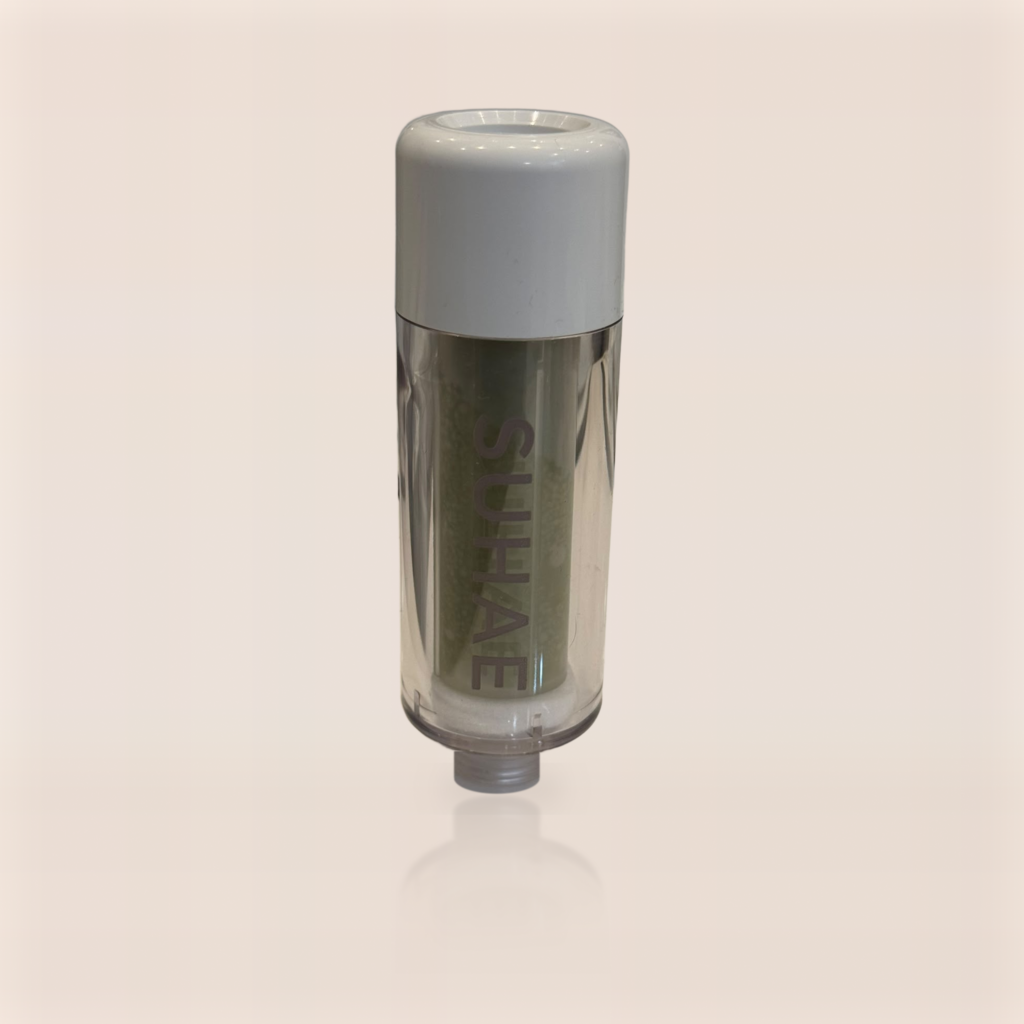
Sitting between the hose and the head, an inline unit filters without changing anything else about the shower. Designed for exactly this retrofit job, the SUHAE universal filter at S$49.90 hand tightens onto a standard thread and comes off the same way when you move out.
- Best for: renters, anyone happy with their current head, and the cheapest honest way into the category.
- Skip if: your head is already old and due for replacement anyway, in which case you are buying two things instead of one.
2. Filtered handshower: filtration and spray in one unit
Built as a single replacement for the head on your hose, a filtered handshower handles spray quality and filtration together. Suitable for daily use on chlorine sensitive skin, the SUHAE Radiance sits at S$149 including one Vitae refill, with the lighter Nourish at S$99. Both are made in Korea and both are covered in our comparison of filtered handshowers.
- Best for: anyone replacing a tired head, or who wants the spray pattern improved at the same time.
- Skip if: you have just bought a head you like, since the inline route costs a third of the price.
3. Overhead or rain set: filtration for a fixed shower
Fixed overhead showers are the awkward case, because most filters are built for a hose. Made for that situation, the SUHAE Aura runs S$249, and the Vitae Connector from S$69.90 adds filtration to an existing rain arm. Worth checking your arm thread before ordering either.
- Best for: renovated bathrooms with a fixed overhead you are not going to remove.
- Skip if: you have a handheld hose, where the simpler formats above do the same job for less.
Whichever format you land on, fitting it is a hand tight job on a standard thread rather than a plumbing project. We walked through the three routes in shower filter installation in an HDB flat.
What to expect after fitting one
Week 1 to 2. The change most people notice first is smell. An enclosed HDB bathroom concentrates the chlorine odour that PUB’s residual is meant to carry, and reducing it is immediate and obvious. Do not expect anything dramatic beyond that in the first fortnight.
Month 1 to 2. Water feel is the second thing, and it is subjective. Some people report that skin feels less tight after a shower, others notice nothing. Both are normal responses and neither proves much on its own.
Month 3 to 6. By now you are into the running cost, which is the part the first purchase never makes obvious. At S$29.90, or three for S$74.90, a Vitae refill lasts two to three months depending on how many people use the shower. That figure, repeated across a year, is the number worth having decided on before you buy anything.
Frequently asked questions
Does a Korean shower filter work differently from any other shower filter?
No. The physics of a Korean shower filter are the same as any other, wherever the housing was moulded. What differs between units is the filtration media, the contact time and the build quality, and origin is a weak proxy for all three.
Is Singapore’s water hard enough to need a filter?
No. At an average total hardness of 42.7 mg/L, Singapore tap water classifies as soft, so hardness is not the reason to filter here. Chloramine contact is the argument, and it is a different argument.
Will a filter reduce my water pressure?
Any restriction in the line costs a little pressure, and a spent cartridge costs more. Some heads offset this with the spray design, which is a separate feature from the filtration and should be assessed separately.
How long does a cartridge last?
Two to three months for most households. A shared flat with four daily showers will get through refills faster than a single occupant, so treat any printed figure as a starting estimate.
Do I need a plumber to fit one?
Not for a hose mounted filter or a replacement head. Both are hand tightened onto the existing thread. A fixed overhead arm is the only case worth a second look, and even then it is usually a matter of checking the thread rather than opening a wall.
What does SUHAE use inside its filters?
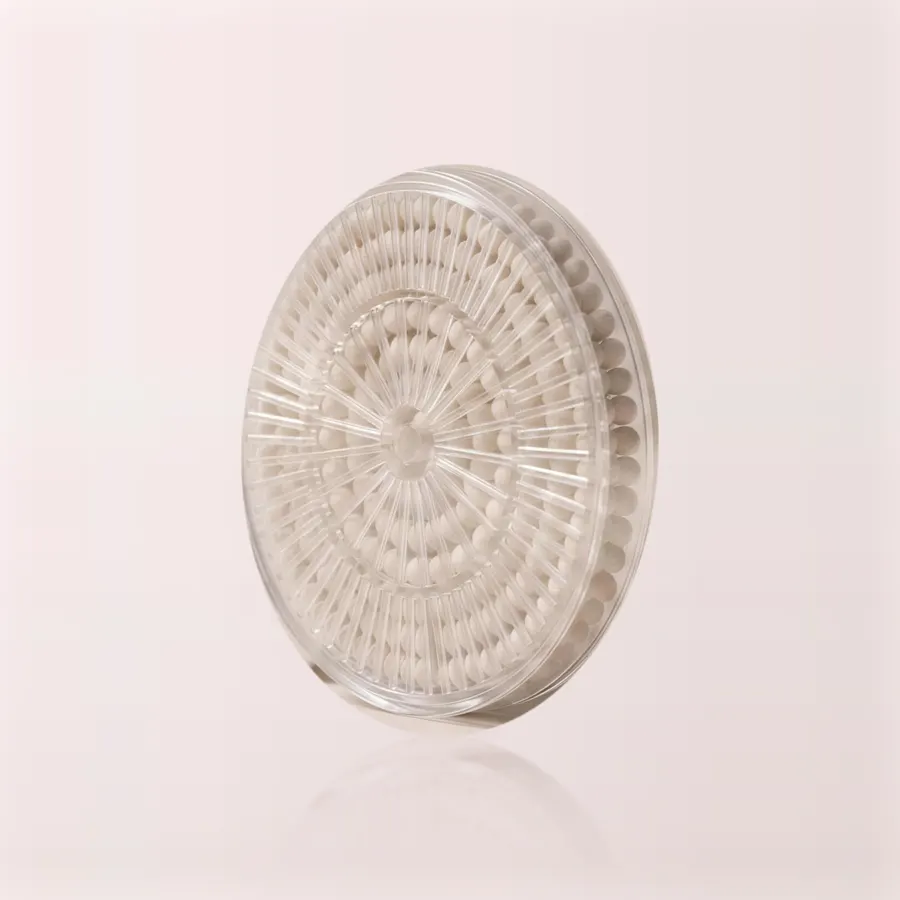
Three parts, all made in Korea. Filtration runs through Purea Core, a three step stage built from SGS tested materials with no detectable cadmium, lead, mercury or hexavalent chromium. Sitting after it, Vitae Infusion carries 25,000 mg of vitamin C with glycerin, milk extract and aloe vera, and helps neutralise chlorine. Separate from both, and on the spray side rather than the filtration side, Aera Flow uses triangular micro jets for perceived pressure and water savings. Warranty covers functional parts only.
References
- PUB, Singapore Drinking Water Quality, January to December 2025: SG-Drinking-Water-Quality.pdf
- PUB, Water Treatment: pub.gov.sg/Public/WaterLoop/Water-Treatment
- PUB, Water Quality: pub.gov.sg/Public/WaterLoop/Water-Quality
- Seki T et al. Free residual chlorine in bathing water reduces the water-holding capacity of the stratum corneum in atopic skin. J Dermatol. 2003. PMID 12692355
- Perkin MR et al. Association between domestic water hardness, chlorine, and atopic dermatitis risk in early life. J Allergy Clin Immunol. 2016. PMID 27241890
If the Korean origin is what brought you here, treat it as a starting point rather than an answer, and spend the extra minute on the cartridge instead. The cheapest way to find out whether filtered water changes anything for you is the inline route, since it keeps the shower you already have and costs less than a month of most other habits. You can also see the units in person at the showroom at T-Space, #01-18, 1 Tampines North Drive 1, Singapore 528559.
