
Hair Care
Can Shower Water Cause Hair Loss? What Singaporeans Need to Know
May
Quick answer: No. There is no good evidence that shower water causes hair loss, and nobody should sell you a product on that basis. Hair loss has many causes, most of them genetic, hormonal, nutritional or dermatological, and anyone losing hair should see a doctor rather than change their shower. Water quality is, at most, a factor in hair condition, meaning dryness, brittleness and colour fade.
This question gets asked a lot, and it usually gets answered badly. The version you find on most product pages quietly slides from hair feeling rough to hair falling out, as though the two were the same problem. They are not, and the difference matters enough to spend an article on.
What actually causes hair loss
Start with the real list, because it explains why water sits so far down it.
Androgenetic alopecia, the pattern thinning that runs in families, accounts for a large share of cases in both men and women. It is driven by genetics and hormones acting on the follicle over years.
Telogen effluvium is the diffuse shedding that follows a shock to the system. Childbirth, a high fever, surgery, rapid weight loss, a stressful few months. Hair follicles shift into their resting phase together and then release together, usually two to three months after the trigger. People often notice it in the shower drain and blame the shower.
Then there is thyroid dysfunction, iron deficiency, certain medications, alopecia areata, scalp conditions such as seborrhoeic dermatitis, and traction alopecia from tight styling worn over long periods. Each has a different treatment, and each is diagnosable.
Tap water appears nowhere on that list. A shower filter does not treat any of these conditions and cannot prevent them.

Shedding from the root, breakage along the shaft
Here is where the confusion starts. Two different things end up in the drain and they look similar to the naked eye.
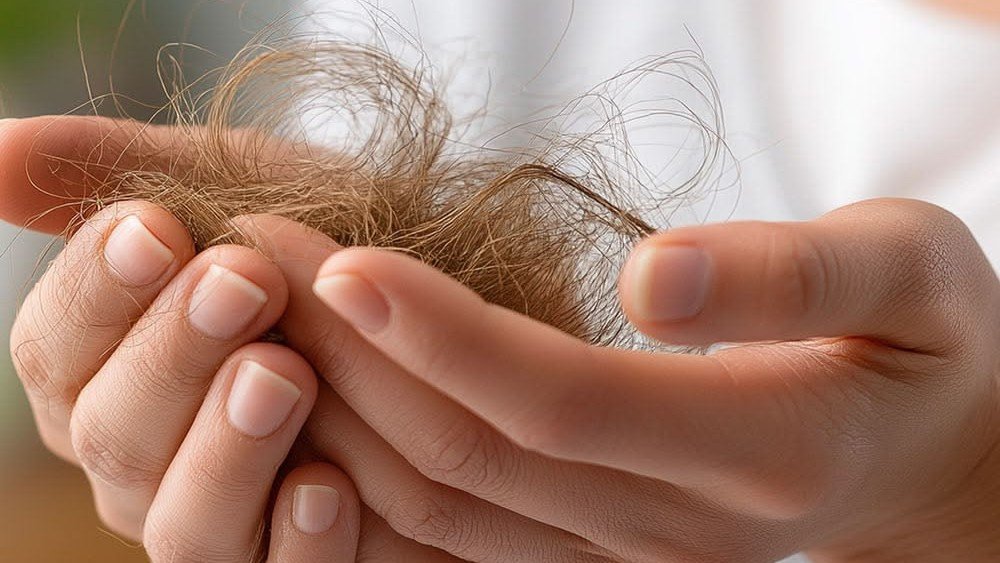
A shed hair comes away from the follicle with a small pale bulb at one end. That is the root, and losing some every day is normal. A broken hair has no bulb. It snapped somewhere along its length because the shaft was weakened, usually by bleach, heat styling, chemical treatment, friction, or simple accumulated wear over the years a long hair has been growing.
Breakage is a condition problem, not a loss problem. It can make hair look thinner, particularly at the ends and around the hairline, without a single follicle having stopped working. If you want to check which one you are seeing, look at the ends of the hairs on your bathroom floor under decent light.
Water quality belongs to this second category, and only weakly. The way water interacts with the structure of the hair shaft is about the cuticle, the overlapping outer layer that keeps moisture in and reflects light.
What is actually in Singapore shower water
PUB’s testing for January to December 2025 recorded free chlorine at an average of 2.27 mg/L, ranging from 1.43 to 2.87, and monochloramine at an average of 2.10 mg/L. The chloramine exists by design. PUB puts it plainly: “Ammonia is added to the treated water to form chloramines, a more stable chlorine residual.”
Total hardness averaged 42.7 mg/L, which classifies as soft. This matters because a great deal of hair and water content online is written for hard water cities and imported wholesale. Mineral buildup on hair strands is a real phenomenon in places with genuinely hard supplies. It is not much of a story at 42.7 mg/L, and the numbers behind that classification are published rather than a matter of opinion.
So the honest mechanism, if there is one at all, is chlorine and chloramine contact affecting the cuticle over repeated daily exposure. Warm water opens the cuticle further, which is why shower temperature changes the exposure picture more than most people expect.
The objection: my hair definitely got worse after I moved
People say this often and they are not imagining it. Something usually did change. The question is whether it was the water.
Moving house tends to coincide with a stack of other changes. A different climate and humidity. New shampoo. More or less air conditioning. A stressful period, which is the classic telogen effluvium trigger with its two to three month delay built in. A new salon. Longer hair than last year, meaning the ends are older and more worn.
It is also worth being clear about the evidence base, because it is thinner than the internet suggests. The most cited work is Seki and colleagues in the Journal of Dermatology in 2003, which found chlorinated water at 1.0 and 2.0 mg/L significantly reduced stratum corneum hydration in patients with atopic dermatitis. That is skin, not hair, and a specific patient group rather than the general population. Perkin and colleagues, in the Journal of Allergy and Clinical Immunology in 2016, examined water hardness and eczema in infancy and concluded that chlorine’s influence remains uncertain. Neither paper says anything about hair falling out, and neither should be presented as though it does.
Who should see a doctor, and who has a condition problem
See a doctor if you are seeing a widening parting, a receding hairline, patches of bare scalp, visible scalp through the hair under normal light, or shedding that has been heavy for more than about three months. See one sooner if it came with fatigue, weight change, or a new medication. Iron studies and thyroid function are simple tests, and treatable causes are far more common than people expect. Delaying that appointment to try a shower accessory is a genuinely bad trade, because some causes respond much better when caught early.
What follows is for a different reader. If your hair volume is stable but the hair itself feels dry, snaps at the ends, tangles more than it used to, or if your colour is fading faster than your colourist predicted, that is condition. It responds to how you treat the hair, including what you rinse it in. The same reasoning sits behind how water quality affects hair moisture locally.
Practical things that help hair condition
Lower the water temperature. Hot water is the most consistent contributor to dryness in a warm country where nobody actually needs a hot shower. Lukewarm is enough.
Handle wet hair gently. It is at its most fragile when saturated, so wide-tooth combs, blotting rather than rubbing with a towel, and no aggressive brushing until it is nearly dry.
Cut heat styling frequency before you change anything else. Thermal damage does more visible harm than any tap water in Singapore.
Get the ends trimmed. Split ends travel upward and no product reverses them. If a chlorine smell in the cubicle is part of what prompted the question, there are a few everyday signs worth checking first.
If chlorine contact is the remaining variable you want to remove, filtration is the tool for that specific job and nothing else. Vitae Infusion carries 25,000 mg of vitamin C that helps neutralise chlorine as water passes through, while Purea Core handles sediment. Refills are S$29.90 each or three for S$74.90, each lasting two to three months, and keeping to that replacement window is what makes the difference between working media and a spent cartridge. The reasonable expectation is hair that feels less rough and colour that holds a little longer, not regrowth. Before spending anything, it is worth reading what a shower filter genuinely removes and who honestly does not need one.
Frequently asked questions
Can chlorine in tap water make my hair fall out?
No evidence supports that. Chlorine contact is discussed in relation to the hair cuticle and skin hydration, not follicle function. If hair is coming out at the root in quantity, the cause is almost certainly something else and worth investigating properly.
Why do I see so much hair in the drain?
Shedding concentrates in the shower because washing and combing dislodge hairs that had already released. Seeing them together is normal. If you wash less often, each wash looks worse without anything having changed.
Is Singapore water hard enough to damage hair?
No. At an average total hardness of 42.7 mg/L the supply is soft, so the mineral buildup story imported from hard water cities does not apply here.
Will a shower filter regrow hair?
It will not, and any brand claiming otherwise is making a medical claim it cannot support. Filtration addresses water contact. Regrowth is a clinical matter for a doctor.
Does colour fade faster in chlorinated water?
Colourists commonly advise against pool swimming for exactly this reason, and tap concentrations are far lower than pool concentrations. It is the most trackable of the condition complaints, which is why protecting colour-treated hair from daily rinsing is worth its own routine.
What does SUHAE claim about hair?
Only that vitamin C media helps neutralise chlorine in the water reaching your hair and skin, which is a chemistry claim rather than a medical one. Nothing sold here treats, prevents or reverses hair loss, and the warranty covers functional parts only, not labour or transport.
References
- PUB Singapore, Drinking Water Quality, January to December 2025. Chlorine, monochloramine and total hardness averages
- PUB Singapore, Water Treatment. Why ammonia is added to form a stable chlorine residual
- Seki T et al., Journal of Dermatology, 2003. Chlorine and stratum corneum hydration in atopic dermatitis, PubMed 12692355
- Perkin MR et al., Journal of Allergy and Clinical Immunology, 2016. Water hardness and eczema in infancy, PubMed 27241890
If you have ruled out the medical causes and what is left is hair that simply feels dry and rough after every wash, filtered water is one variable you can remove without much effort. Have a look at the vitamin C shower head range, and keep your expectations set on hair condition rather than hair count.
