
Water Quality & Chlorine
What Does a Shower Filter Actually Remove in Singapore Homes?
May
Quick answer: A shower filter in Singapore mainly reduces the residual chlorine and chloramine that PUB keeps in the supply so water stays safe on its way to your tap, along with fine sediment and rust picked up inside building pipework. It does not soften water, and it does not make safe water safe. The real list is shorter than most marketing suggests, which is precisely why it is worth knowing.
Most people start looking into this after something small changes. Skin that feels tight a few minutes after towelling off. Hair that dries rougher than it did in the old flat. The question underneath all of that is narrow, and it deserves a narrow answer rather than another benefits list.
What is actually in Singapore shower water
PUB publishes its numbers, and they are worth reading before you buy anything. In the January to December 2025 report, free chlorine averaged 2.27 mg/L across the network, with a range of 1.43 to 2.87 mg/L. Monochloramine averaged 2.10 mg/L. Total hardness averaged 42.7 mg/L. Average pH was 8.0.
The chloramine figure surprises people. PUB states the reason plainly: “Ammonia is added to the treated water to form chloramines, a more stable chlorine residual.” Stability is the point. A more stable residual survives kilometres of mains and the riser in your block, which is good for public health and slightly awkward for a filter, because stable compounds are harder to strip out in the second or two water spends inside a cartridge. The longer version of why treated water still carries a disinfectant by the time it reaches your bathroom sits in a separate article.
Hardness is where a lot of imported marketing goes wrong. At 42.7 mg/L, the local supply classifies as soft, so limescale and mineral crusting are not the problem here that they are in London or Hong Kong. If you have read the opposite claim on a product page, the numbers behind how Singapore water compares to genuinely hard supplies settle it.
The mechanism: what the media inside a cartridge does
Three approaches dominate, and they work differently. Activated carbon works by adsorption. Chlorine sticks to the very large internal surface area of the carbon. It is well proven and cheap, though performance falls off as contact time shortens and as water gets hotter, both of which describe a shower.
KDF media, a copper and zinc alloy, works by redox. Electrons move between the metals and dissolved chlorine, converting it into chloride, and it handles heat better than carbon.
Ascorbic acid, better known as vitamin C, works by chemical reduction. Suitable for the very short contact time a shower allows, it reacts with chlorine to form chloride fast enough to matter at real flow rates. The trade-off is that it is consumed as it works, so it has to be replaced on a schedule. A closer look at the reaction between ascorbic acid and chlorinated water is worth ten minutes if the chemistry interests you.
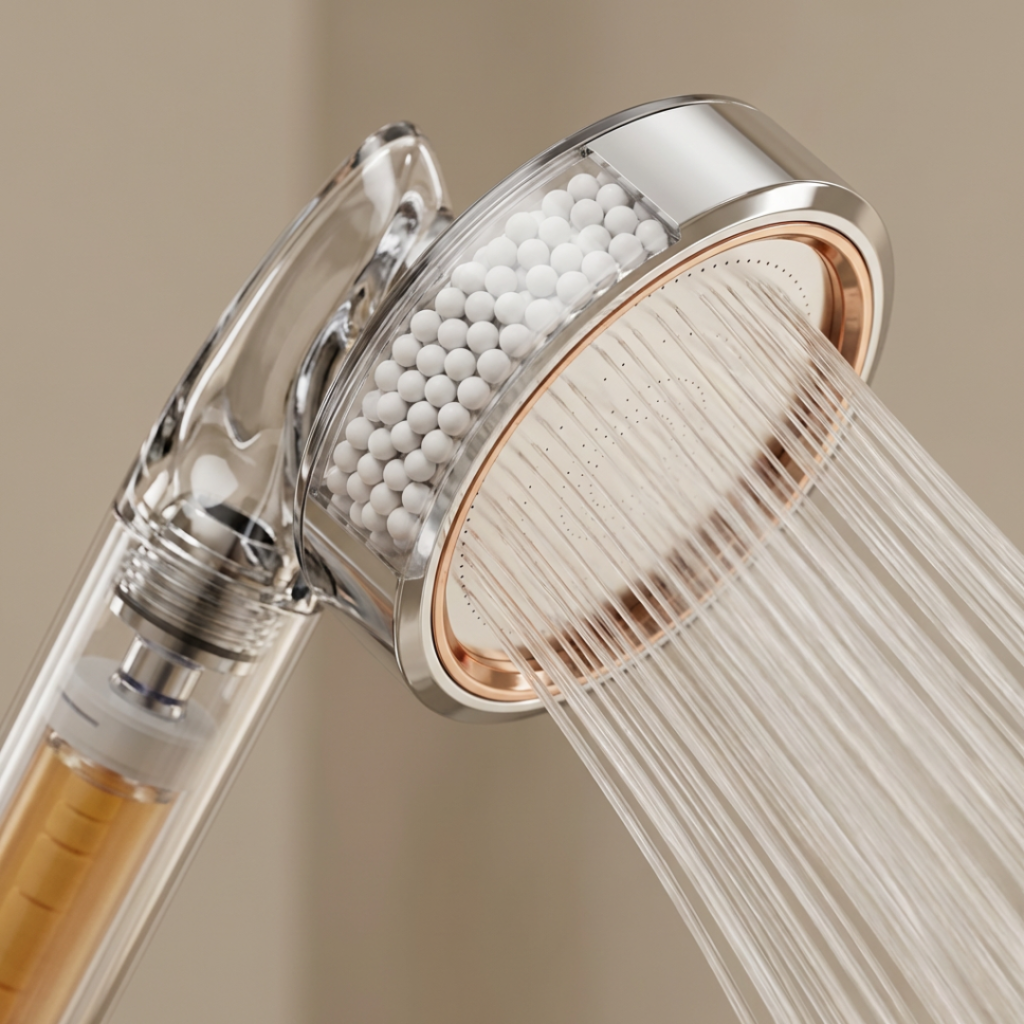
Most cartridges sold today stack two or three of these together with a mechanical layer. We have broken down what the individual layers in a modern cartridge usually are if you want to compare specifications properly rather than by price.
Sediment, rust and the pipework nobody sees
The second thing a filter catches is physical rather than chemical. Water leaves the treatment works clean, then travels through mains, into a building riser, past a heater, and finally into your shower arm. Every one of those stages can shed something.
In older resale flats, fine rust is common enough that residents notice an orange tinge in a white basin after the supply has been shut off for maintenance. A mechanical stage, usually fabric or ceramic, traps that debris. It is the least glamorous function of a shower filter and the easiest to verify. Pull the cartridge after two months and look at it. What is on the surface is what did not land on your skin. Some of what people assume is a water quality issue turns out to be a fixture issue, one of the things worth ruling out before blaming the water itself.
The obvious objection: PUB water already meets WHO guidelines
It does, and nothing here disputes it. Singapore tap water is safe to drink straight from the tap, it is tested continuously, and the results are published. Anyone selling a filter on the basis that your drinking water is dangerous is misleading you.
The honest case is narrower. Safe to drink is not the same thing as optimal for ten minutes of daily skin contact. Shower water sits on the outermost layer of skin, at around 40 degrees, often twice a day in this climate, for years.
Even so, the published evidence is thinner than most brands admit. Seki and colleagues, writing in the Journal of Dermatology in 2003, found that chlorinated water at 1.0 and 2.0 mg/L significantly reduced stratum corneum hydration in patients with atopic dermatitis. That is a real result in a specific group, and it should not be stretched to cover everybody. Perkin and colleagues, in a 2016 paper in the Journal of Allergy and Clinical Immunology, examined water hardness and eczema risk in infancy and concluded that chlorine’s influence remains uncertain. Uncertain is the accurate word.
Who this is for, and who can skip it
Worth considering if you shower twice a day, as most households here do. Also worth considering if colour-treated hair fades faster than your colourist predicted, if your skin runs dry or reactive, or if you live in an older block with pipework you have never seen.
This earns its place when something already bothers you about the water. If nothing does, there is no urgency. If your skin feels comfortable and your hair behaves, a filter solves a problem you do not have. Skip it if you are renting short term. Skip it if you are hoping it will deal with limescale, because at 42.7 mg/L there is very little scale to deal with. And if you have a genuine skin or scalp condition, see a doctor before buying anything. Filtration is a comfort measure, not a treatment, and treating it as one delays care that would actually help.
Practical guidance if you decide to try one
Two formats exist. A retrofit filter screws in between your existing hose and shower head, so you keep the fixture you already chose. A filtering shower head replaces the head entirely. Both fit standard HDB and condo threads without a plumber, and the universal retrofit filters start at S$49.90, which is the cheaper way to find out whether filtration changes anything for you.
Replacement cadence is what people underestimate. Vitamin C media is consumed as it reacts, so a cartridge running six months is doing very little beyond catching grit. Two to three months is realistic for a household showering daily, and the signs that a cartridge is past its useful life are easy to spot once you know them.
One comparison is worth making first. A shower filter and a whole-house softener solve different problems, and in Singapore only one of those problems really exists, which is the point of setting a filter against a softener on local numbers.
Frequently asked questions
Does a shower filter remove all the chlorine?
The SUHAE vitamin C filter removes 99.9% of chlorine. It works on chloramine as well, and a fresh cartridge when one is due keeps it at its best.
Does it remove bacteria?
Treat that claim carefully. Water arrives at your block already disinfected, so bacterial load is not the problem a shower filter is designed around. Credible filtration claims stay focused on chlorine, chloramine and particulates.
Will it soften the water?
No. Softening needs an ion exchange resin bed and a salt regeneration cycle, neither of which fits inside a shower cartridge. Given the 42.7 mg/L average, there is not much to soften in the first place.
Does adding a filter reduce water pressure?
A well designed cartridge adds very little resistance. A clogged or overdue one adds plenty. If pressure drops noticeably after a few months, the cartridge is usually the cause, and the pressure question deserves its own read before you blame the plumbing.
Will I notice a difference straight away?
The chlorine smell is the most immediate and least subjective change, and some people notice it on the first use. Skin and hair feedback takes longer, usually a few weeks. Judge on something specific rather than a general impression.
What is inside SUHAE’s filtration specifically?
Purea Core handles the mechanical and media stages. Vitae Infusion carries 25,000 mg of vitamin C that helps neutralise chlorine as water passes through. Refills are S$29.90 each, or three for S$74.90, and each one lasts two to three months in normal daily use. The warranty covers functional parts only, not labour or transport.
References
- PUB Singapore, Drinking Water Quality, January to December 2025. Read the published test results
- PUB Singapore, Water Treatment. How chloramines are formed in the local supply
- Seki T et al., Journal of Dermatology, 2003. Chlorine and stratum corneum hydration in atopic dermatitis, PubMed 12692355
- Perkin MR et al., Journal of Allergy and Clinical Immunology, 2016. Water hardness and eczema in infancy, PubMed 27241890
If you want to test the idea with the smallest possible commitment, the retrofit route is the honest place to start. It keeps the shower head you already have, costs S$49.90, and gives you a clear answer within two months about whether filtered water changes anything for your skin and hair. Have a look at the universal shower filter options and decide from there.
