
Skin Care
Shower After Swimming: What the Post-Swim Rinse Is For
Sep
Quick answer: A shower after swimming works best as a rinse, not a full wash. Pool water in Singapore is held at 1 to 3 parts per million of free chlorine under NEA’s licensing requirements, and what dries on your skin afterwards is that water together with the chloramines it formed while you were in it. Rinsing within a few minutes, with plain water and without scrubbing, removes most of it.
You towelled off on the pool deck, walked back up to the flat, and the smell was still on your forearms at dinner. Most advice at that point is about masks and moisturiser, which treats the residue as something to cover rather than remove. The more useful question is what the water leaves behind, how long it sits there, and which part of the rinse does the work.
What a pool actually leaves on your skin
Condominium and public pools here are licensed facilities with published numbers behind them. NEA’s Licensing Requirements for Aquatic Facility, issued 17-08-2023, sets daily free chlorine at 1 to 3 ppm for swimming pools, 3 to 5 ppm for spa pools, with pH between 7.2 and 7.8 and a monthly sample sent to a laboratory accredited by the Singapore Accreditation Council. Those are operating targets, not warning levels. A pool sitting at 2 ppm is doing the job it is licensed to do.
What changes the picture is what that chlorine meets once a crowd is in the water. CDC guidance for pool operators puts it plainly: “when it binds to the body waste swimmers bring into pools, it can form chemicals called chloramines”. The smell most people call chlorine is largely that reaction product rather than the disinfectant itself, the same distinction we drew about the sharp smell that sometimes comes off a tap at home. Worth holding the two apart, though: pool chloramines form in the water from swimmers, while the monochloramine in Singapore tap water is added deliberately at the treatment works.
Then you get out, and the film on your skin stops being pool water and starts being pool water that is evaporating. The water leaves. Everything dissolved in it stays. Forty minutes between the pool deck and your bathroom is forty minutes of contact at a concentration creeping slowly upward, alongside whatever sunscreen and sweat dried down with it. Contact time is the one variable you fully control, which is why when you rinse matters more than what you rinse with.
This is not an argument against the pool
Disinfection is the reason a shared pool is usable at all, and NEA’s 1 to 3 ppm band exists because a pool below it stops doing its job. Swim as often as you like. The rinse is a housekeeping step, on the same shelf as taking your shoes off at the door.
The published evidence on chlorinated water and skin is narrower than most wellness writing suggests. Seki and colleagues, in the Journal of Dermatology in 2003, found that chlorine at 1.0 to 2.0 mg/L reduced stratum corneum hydration in patients with atopic dermatitis. That finding is scoped to those patients, and stretching it to everyone goes past what the paper says. We drew the same line on chlorine exposure and skin irritation, and it holds here: the case for rinsing rests on contact time and residue, not on a condition.
Who this matters for, and who can leave it alone
Worth making a shower after swimming a fixed habit if you swim three or more times a week, if you are in the water an hour at a stretch, or if you have coloured or chemically treated hair that already needs managing. Worth it too if you swim outdoors around midday, because sunscreen, sweat and pool water dry down together into a film a towel does not lift.
A weekend swimmer who uses the pool shower within ten minutes has already done the part that counts, and nothing further is needed. The same applies to anyone whose skin feels fine after a swim. Comfort is the signal, and a routine built for a problem you do not have is just more steps in the evening.
Three ways to handle the post-swim rinse
1. The poolside rinse: the one that does most of the work
Thirty seconds under the pool shower before you towel off lifts the bulk of the residue while it is still liquid, which is the easiest state it will ever be in. CDC gives operators the same instruction for the trip in the other direction, asking that swimmers “rinse off before getting into the water”. It works on the way out for the same reason.
- Best for: anyone swimming where there is a working poolside shower, which in most condos there is.
- Worth knowing: it is unfiltered and often cold, so it handles removal and leaves comfort to your shower at home.
2. The shower at home: where the routine gets decided
Warm water, a mild cleanser where you need one, and out. Scrubbing a swim off tends to do more than the residue did. One thing surprises people here: the water doing the rinsing is not blank. PUB’s figures for January to December 2025 put total chlorine in Singapore tap water at an average of 2.27 mg/L and monochloramine at 2.10 mg/L, both well inside WHO guideline values and both, on paper, in the same range as the pool you just left. Safe to drink is a different test from ten minutes of daily skin contact, which is the argument we make in does Singapore tap water affect your skin.
Mineral scale you can stop worrying about. PUB’s average total hardness is 42.7 mg/L, which classifies as soft, so the limescale advice imported from British and American swim blogs does not apply to a flat here. We unpacked that in hard water versus soft water.
- Best for: the swim you cannot rinse off immediately, and for anything involving hair.
- Worth knowing: a long hot shower after a long swim adds contact time rather than removing it, so keep it short and warm rather than hot.
3. Filtration at the head: for the rinse you take most often
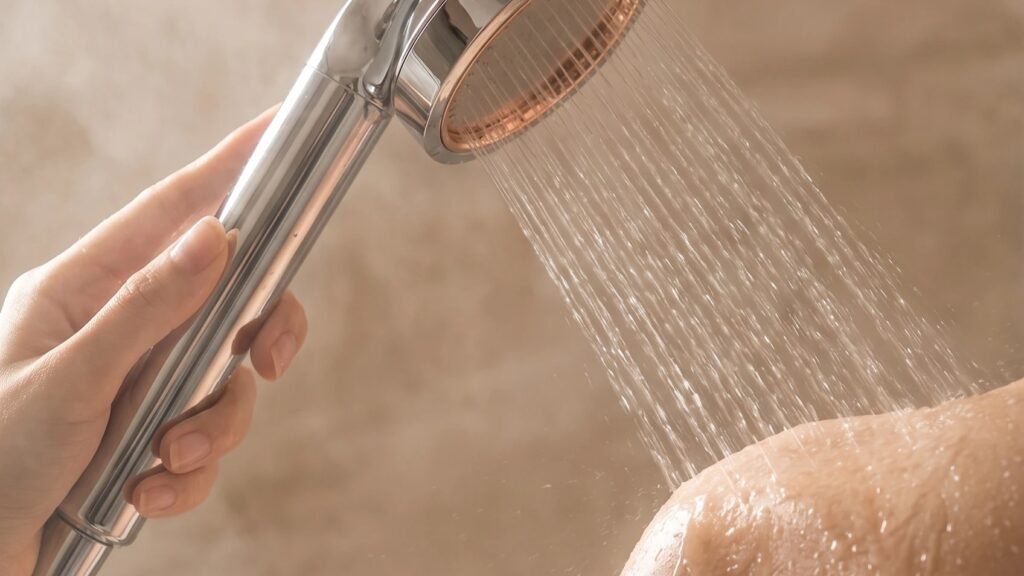
Fitted to the shower you already use every evening, a filtration stage changes the water in the rinse rather than the rinse itself. Ascorbic acid reacts with free chlorine and chloramines in solution, which is why a vitamin C stage helps neutralise what is in the supply, and we set out how that works in how vitamin C handles chlorine in shower water. Suited to households already showering twice a day in this climate, the vitamin C shower heads build that stage into the handset, while the universal retrofit at S$49.90 adds it between the hose and whatever head is already on the wall. Both run on the same Vitae refill, which lasts 2 to 3 months in typical use.
- Best for: daily swimmers, and anyone whose post-swim shower is the third or fourth shower of the day anyway.
- Worth knowing: this changes your home water, not the pool water you arrive with. Removing pool residue is the rinse’s job, and the cartridge has nothing to do with it.
What to expect from a shower after swimming
Week 1 to 2. The smell stops following you home. That is the whole of the early result, and it comes from timing rather than from any product: rinse inside ten minutes and the residue never gets the chance to dry down.
Month 1 to 2. Hair is usually where a change shows first, particularly if it is coloured, since a swim and a shower land back to back several times a week. Coloured hair holds onto the difference more visibly than skin does.
Month 3 to 6. By now the rinse is automatic and nobody is thinking about it, which is the point. The honest version of the result is a small thing repeated often: less residue sitting on skin for less time, several hundred times a year, rather than a transformation.
Frequently asked questions
Should I shower before swimming as well?
Yes, and CDC asks pool operators to require it. A quick rinse removes much of the sweat, sunscreen and lotion that combine with chlorine to form chloramines, which keeps the water better for everyone in it.
Straight away at the pool, or wait until I get home?
Straight away, if there is a working shower. A cold thirty-second rinse on the deck beats a perfect one an hour later.
Do I need soap after a swim?
A mild cleanser where you would normally use one is plenty. Pool residue is water-soluble, so the water is already doing most of the removal.
Does a strong pool smell mean too much chlorine?
Usually the opposite. A pronounced smell points to chloramines, and a pool showing that is often one where free chlorine is being used up faster than it is replaced. NEA requires operators to test free chlorine and pH daily.
What about my hair after swimming?
Rinse it before you get in as well as after, since hair already saturated with clean water takes up less pool water. Water quality and hair structure covers what happens at the cuticle.
Does a SUHAE filter help with pool water?
Our filters treat the water coming out of your own shower, which is the water doing the rinsing, and they help neutralise the chlorine and chloramines in that supply. Pool residue is removed by the rinse itself, so the two jobs sit side by side. Refill timing is worth a look if you shower more than twice a day.
References
- National Environment Agency, Licensing Requirements for Aquatic Facility (AF), issued 17 August 2023. nea.gov.sg
- NEA, Aquatic Facilities Water Quality. nea.gov.sg
- Centers for Disease Control and Prevention, Chloramines and Pool Operation, Healthy Swimming. cdc.gov
- PUB, Singapore Drinking Water Quality, January to December 2025. pub.gov.sg
- PUB, Water Treatment. pub.gov.sg
- Seki T et al. Free residual chlorine in bathing water reduces the water-holding capacity of the stratum corneum in atopic skin. Journal of Dermatology, 2003. PMID 12692355. pubmed.ncbi.nlm.nih.gov
Rinse early, keep it short, and the shower after swimming looks after itself. For the shower afterwards, the one you take again tomorrow whether or not you swim, filtration is the only part of it you can change, and a handset with the Vitae stage built in is the simplest way to do it. The showroom at T-Space, #01-18, 1 Tampines North Drive 1, Singapore 528559 has them running if you would rather feel the spray first.
